














Are generic drugs reliable? What scientific evidence and Brazilian regulations tell prescribers
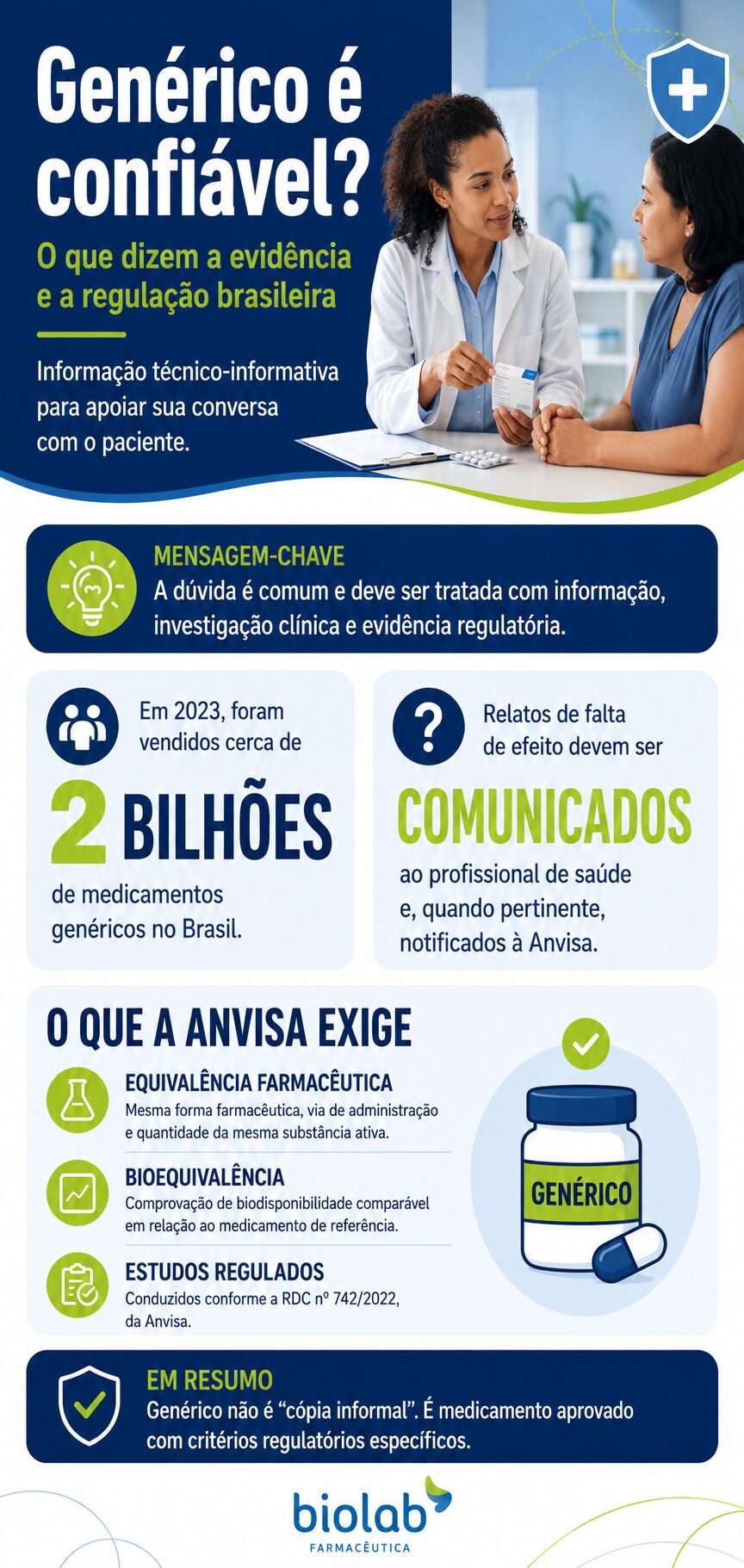
The market for generic drugs in Brazil continues to grow. According to the Federal Pharmacy Council, based on data from PróGenéricos, approximately 2 billion generic drugs were sold in the country in 2023. Even so, many patients still come into the doctor’s office with a direct question: “Doctor, are generic drugs reliable?”.
Doubt should not be treated as irrational. It may be linked to individual experiences, third-party accounts, price differences, a change in manufacturer, or a lack of knowledge about the regulatory criteria used to approve these products. For prescribers, organizing this information clearly helps distinguish between individual perceptions, clinical research, and regulatory evidence.
This content provides a technical and informative overview of what Brazilian regulations and public health sources say about quality, pharmaceutical equivalence, bioequivalence, and the monitoring of generic drugs. The goal is to support safer communication with patients, without replacing individual clinical evaluation.
Where does the mistrust of generic drugs come from, and why does it persist?
Brazil’s generic drug policy was established by Law No. 9,787 of 1999. Since then, generic drugs have become part of the national policy on access to medicines and have been regulated by technical criteria for registration, quality, and health monitoring.
In clinical practice, skepticism may arise when a patient reports that “the generic drug didn’t work” or that they noticed a difference after switching products. According to Anvisa’s guidelines on suspected lack of efficacy of medications, this type of report should be communicated to the doctor or pharmacist and, when appropriate, reported to the agency. Anvisa itself acknowledges that the perception of a lack of effect may be related to the patient’s health status, but it may also involve suspicion of a technical defect in the product, which requires proper evaluation.
Therefore, individual reports should be heard and investigated. They should not be automatically dismissed, but neither do they justify the conclusion that generic drugs, as a category, are inferior to the reference drug.
What Anvisa Requires to Approve a Generic Drug in Brazil
For a generic drug to be registered in Brazil, Anvisa requires proof of pharmaceutical equivalence and bioequivalence with respect to the reference drug.
Pharmaceutical equivalence refers to the comparison between the test drug and the reference drug in terms of dosage form, route of administration, and the amount of the same active ingredient. When analyzing pharmaceutical equivalence studies, Anvisa refers to RDC No. 31/2010 for the definition of pharmaceutical equivalents, which must meet the quality requirements set forth in official compendia, recognized standards, or regulations.
Bioequivalence, according to Anvisa, consists of demonstrating pharmaceutical equivalence between products presented in the same dosage form, with identical qualitative and quantitative composition of the active ingredient, and comparable bioavailability when evaluated under the same experimental design.
Regulatory Directive No. 742/2022 sets forth the criteria for conducting relative bioavailability/bioequivalence studies and pharmacokinetic studies. This is the most appropriate regulatory framework for explaining how these studies are conducted and evaluated in the Brazilian context.
So, yes, the generic version is reliable.
Bioequivalence in Practice: What the Tests Actually Prove
A bioequivalence study compares the pharmacokinetic profile of the test drug with that of the reference drug under controlled conditions. Among the parameters evaluated are the maximum plasma concentration of the drug, known as Cmax, and the area under the plasma concentration-time curve, known as AUC.
In practice, these studies do not demonstrate that two products are identical in all aspects of their formulation. They demonstrate that their pharmacokinetic performance is comparable within the applicable regulatory criteria. Therefore, the most reliable technical conclusion is that the generic drug approved by Anvisa has demonstrated bioequivalence with the reference drug in the parameters required for registration.
This distinction is important for communicating with patients: “generic” does not mean “unauthorized copy” or “untested product.” It means a drug approved under specific regulatory criteria, which include comparisons of quality and performance relative to the reference drug.
Frequently Asked Questions About Generic Drugs and What the Regulatory Evidence Says
Generic drugs contain less active ingredient
Pharmaceutical equivalence requires that the test drug contain the same amount of the same active ingredient as the reference drug, taking into account the dosage form and route of administration. Differences may exist in excipients or in specific formulation characteristics, provided they do not compromise the applicable regulatory criteria for equivalence.
Generic medication works only for mild cases
Under regulatory logic, there is no distinction based solely on the severity of the clinical condition. An approved generic drug must meet the criteria required for its registration. Nevertheless, the decision to continue using, switch to, or avoid substituting a product must take into account the clinical condition, the individual’s response, the treatment history, and the prescriber’s assessment.
A different excipient may alter the effect
Excipients may vary between generic and reference drugs. The bioequivalence study is designed precisely to assess whether the product has comparable bioavailability within the required criteria. Nevertheless, in patients with allergies, intolerances, specific restrictions, or a history of reactions to components of the formulation, the composition must be evaluated on a case-by-case basis.
My patient's condition worsened when he switched to the generic version
Reports of worsening symptoms or the perception that a medication is not working should be investigated. Anvisa advises that, if a patient suspects a medication has not produced the expected effect, they should speak with a doctor or pharmacist and, when appropriate, report the problem to the agency.
In the clinical evaluation, factors such as adherence to treatment, correct use, drug interactions, storage, changes in manufacturer, disease progression, and the patient’s expectations regarding treatment may be considered. The literature also describes the nocebo effect, in which negative expectations can influence the perception of symptoms or therapeutic response. This point should be approached with caution, without dismissing the patient’s reported experience.
Objective criteria for evaluating the pharmaceutical quality of a generic drug
When a prescriber wishes to go beyond general trust in the regulatory system and evaluate the suitability of a specific product, certain criteria can be helpful:
• verify that the drug has an active registration with Anvisa;
• verify whether the manufacturer holds a Good Manufacturing Practices (GMP) Certificate, where applicable;
• encourage purchases through legitimate channels, with a receipt, intact packaging, and identifiable lot number and expiration date;
• Consider product traceability and the possibility of notification in the event of a suspected quality deviation or therapeutic failure.
These criteria do not replace clinical judgment, but they provide objective benchmarks for a more informed discussion about the origin, safety, and reliability of the treatment.
Quality, traceability, and good manufacturing practices
The quality of a drug does not depend solely on its active ingredient. It involves manufacturing controls, stability, packaging, storage, distribution, and post-marketing surveillance.
The Certificate of Good Manufacturing Practices is one of the regulatory tools used by Anvisa to certify that a particular manufacturing facility has been inspected and complies with applicable health standards. In the event of significant nonconformities, the agency may take health measures commensurate with the identified risk.
For both prescribers and patients, it is also important to emphasize the importance of purchasing medications from authorized retailers. Medications purchased outside formal channels—without batch traceability or with tampered packaging—make it more difficult to verify the product’s origin and integrity.
How to Ask Whether a Generic Drug Is Reliable During a Doctor's Visit
A patient’s concerns are rarely purely technical. Often, they involve fear of receiving something “inferior,” surprise at the price difference, or the influence of past experiences.
Here are a few approaches that might help:
• explain that generic drugs approved by Anvisa undergo regulatory evaluation and comparative studies with the reference drug;
• distinguish between an individual account and a general conclusion about the category;
• address the concern without reinforcing the myth of inferiority;
• instruct the patient on proper use, storage, lot number, expiration date, and clinical response;
• investigate reports of loss of efficacy or unexpected reactions, without disregarding the patient’s experience;
• When there is a clinical need to continue using a specific brand, explain the reason without applying this caution to all generic drugs.
Trust is built through clear information, active listening, and transparency. When regulatory criteria are communicated in an accessible way, discussions about generic drugs tend to promote adherence, safety, and a better understanding of the treatment.
Frequently Asked Questions About the Reliability of Generic Drugs
Are generic drugs reliable for long-term use in chronic conditions?
The generic drug approved by Anvisa has demonstrated bioequivalence with the reference drug within the applicable regulatory criteria. There is no inherent restriction on the “generic” category for long-term use, provided that the drug is duly approved and is used as prescribed and under professional supervision.
How can you tell if a generic drug has been approved by Anvisa?
The prescriber or patient can consult Anvisa’s drug database. Searches can be performed by drug name, active ingredient, manufacturer, or registration number. Products with a valid registration have met the applicable regulatory criteria.
Does Anvisa use internationally recognized criteria for bioequivalence?
RDC No. 742/2022 updated the criteria for relative bioavailability/bioequivalence studies and pharmacokinetic studies, seeking greater alignment with available scientific knowledge and international convergence. Therefore, the Brazilian evaluation follows technical parameters structured for this type of study.
What should you do when a patient reports that the generic drug “didn’t work”?
The safest recommendation is to investigate before drawing conclusions. One should assess correct use, adherence, duration of treatment, storage, interactions, clinical course, and a possible change in manufacturer. When therapeutic failure or a quality issue is suspected, Anvisa advises that the case be communicated to the physician or pharmacist and reported to the agency.
How can we assess the pharmaceutical quality of a generic drug manufacturer?
It is possible to verify current registration status, compliance with health regulations, a Good Manufacturing Practices (GMP) certificate, batch traceability, formal distribution channels, and transparency regarding quality controls. These factors do not replace clinical judgment, but they help support a more objective assessment.