














Stretching for Joint Pain: Simple Exercises for People Who Experience Stiffness and Want to Move Better in Their Daily Lives
Getting up from a chair, climbing stairs, squatting to pick something up off the floor, or turning your neck while maneuvering a car are simple movements, but they can become more difficult when there is pain or stiffness in the joints. For adults who spend many hours sitting or have a sedentary lifestyle, this discomfort may occur upon waking up, after long periods of rest, or when resuming everyday movements. That’s where the importance of stretching for joint pain comes in.
Joint pain can have various causes. In some cases, it is related to changes in structures such as cartilage, bones, tendons, ligaments, and muscles surrounding the joint. According to the Brazilian Society of Rheumatology, osteoarthritis, also known as arthrosis, is one of the most common rheumatic diseases and becomes more prevalent with advancing age, although it is not caused solely by aging.
A lack of physical activity also warrants attention. According to the World Health Organization, a sedentary lifestyle is associated with poorer health outcomes, and any safe increase in physical activity can contribute to overall health. When it comes to the joints, gradually increasing physical activity can help preserve function, reduce stiffness, and improve one’s ability to perform daily activities.
This guide explains how stretching can be part of a self-care routine, what precautions are important, and when joint pain requires professional evaluation. The information provided is for educational purposes only and is not a substitute for a consultation with a doctor, physical therapist, or other healthcare professional.
Why Joints May Hurt More as We Get Older
Joint pain in adults can result from various factors, such as a sedentary lifestyle, being overweight, a history of injuries, repetitive strain, postural problems, individual predisposition, and rheumatic diseases. The Brazilian Society of Rheumatology notes that osteoarthritis becomes more common with age and can affect joints such as the knees, hips, hands, and spine.
People who spend many hours sitting may also experience stiffness due to reduced movement throughout the day. Staying in the same position for long periods can lead to muscle tension in areas such as the hips, the back of the thighs, the lower back, the shoulders, and the neck. As a result, simple movements may seem more difficult, especially when standing up after long periods of inactivity.
It is important to observe the pattern of the pain. Mild stiffness that improves with gradual movement may present differently from pain accompanied by swelling, localized warmth, redness, fever, locking, progressive loss of movement, or continuous worsening. In such cases, a professional evaluation is necessary to investigate the cause.
Can stretching help with joint pain?
Stretching can help reduce stiffness and improve range of motion in some people, especially when done gently, gradually, and without pain. However, it should be viewed as a complementary measure, not as a standalone treatment.
International guidelines for the care of osteoarthritis, such as those from the American College of Rheumatology and the Arthritis Foundation, recommend exercise as an important part of nonpharmacological management. The NHS also advises that people with osteoarthritis benefit from a combination of exercises to strengthen muscles and improve overall fitness, with a plan tailored to each person’s individual circumstances.
For this reason, stretching tends to be most effective when it is part of a broader strategy, which may include strength training, walking, or other low-impact aerobic activities, weight management when appropriate, and professional guidance when necessary.
The goal is not to “eliminate” pain or replace physical therapy or medical treatment. The aim is to promote mobility, reduce muscle tension, and help people move more safely within their own limits.
Precautions before starting, especially for people with high blood pressure or high cholesterol
People with controlled high blood pressure or high cholesterol can generally benefit from a safe exercise routine. The American Heart Association recommends that adults reduce the amount of time they spend sitting, gradually increase their physical activity, and include strength training and stretching exercises as tolerated and under appropriate guidance.
Still, there are some precautions to keep in mind (Mayo Clinic):
• Avoid holding your breath while stretching. Breathe continuously and calmly, without straining.
• Choose stable positions. Use a wall, a sturdy chair, or a nearby support when necessary.
• Do not push yourself to the point of pain. You should feel mild to moderate tension, never sharp pain.
• Avoid sudden movements, especially if you experience dizziness, loss of balance, or are taking medications that may affect your blood pressure.
• Seek medical advice before starting a new exercise routine if you have uncontrolled high blood pressure, chest pain, shortness of breath with minimal exertion, frequent dizziness, or a recent history of a cardiovascular event.
These precautions should not be viewed as obstacles, but rather as simple measures to make the practice safer.
Simple stretches to do at home, without equipment
The exercises below can be done at home without any equipment, as long as they do not cause acute pain, dizziness, tingling, shortness of breath, a significant worsening of symptoms, or radiating pain. Do everything slowly, without “bouncing” and without trying to achieve maximum range of motion (Mayo Clinic).
If you have a diagnosed joint condition, a recent injury, a history of surgery, severe pain, or significant mobility limitations, talk to a healthcare professional before you begin.
For the knees and the back of the thighs
Sit on the edge of a sturdy chair. Extend one leg forward, with your heel resting on the floor. Keep your spine straight and lean your torso slightly forward until you feel a gentle stretch in the back of your thigh. Hold for 20 to 30 seconds, then switch sides.
This movement can help reduce stiffness in the hamstrings, which contribute to hip mobility and influence knee mechanics.
For the hips and hip flexors
Standing with a wall or chair nearby for support, take a wide step forward with one leg. Slightly bend your front knee, keep your torso upright, and gently shift your hips forward until you feel a stretch in the front of your back thigh. Hold for 20 to 30 seconds, then switch sides.
This stretch can be helpful for people who spend many hours sitting, since the front of the hip tends to become tight after long periods in the same position.
For the lumbar spine
Lie on your back on a firm surface. Pull one knee toward your chest with both hands, keeping the other leg straight or slightly bent, whichever is more comfortable. Hold for 20 to 30 seconds, then switch sides.
The movement should create a sensation of gentle stretching. If you experience pain that radiates down your leg, tingling, loss of strength, or worsening lower back pain, stop and seek professional advice.
For the shoulders and upper back
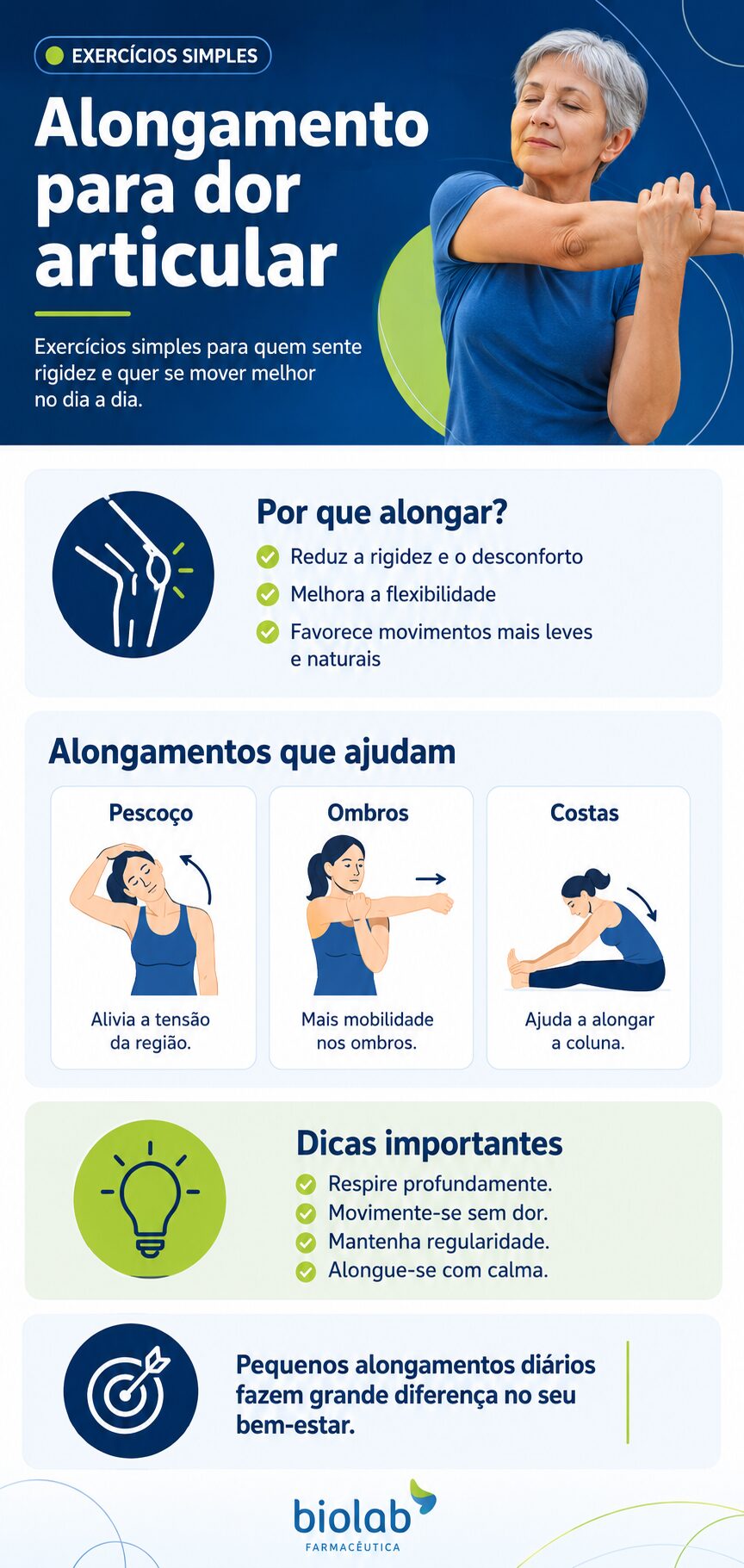
Whether standing or sitting, cross one arm in front of your chest. Use your opposite hand to gently pull it toward your body. Keep your shoulders relaxed and avoid lifting your neck. Hold for 20 to 30 seconds, then switch sides.
This stretch can relieve tension in the shoulders and upper back, especially for people who work for long periods in front of a computer.
How often should you stretch?
Consistency is usually more important than intensity. Based on flexibility training recommendations from the American College of Sports Medicine, static stretches can be performed at least 2 to 3 times a week, holding each position for about 15 to 30 seconds, while respecting individual limits.
In practice, a short routine—10 to 15 minutes—can be a good starting point for many people. Beginners can start with a shorter duration and gradually increase it, as long as they don’t experience pain or a worsening of symptoms.
Improvements in flexibility tend to be gradual. Some people experience temporary relief immediately after exercising, while more consistent changes in mobility depend on consistency, proper technique, and combining these exercises with other movement habits.
When Joint Pain Requires More Than Just Stretching
Stretching may help with some types of stiffness, but it should not delay the investigation of warning signs. Seek professional evaluation if you experience:
• pain that is persistent, progressive, or wakes you up at night;
• swelling, redness, or warmth in the joint;
• fever associated with joint pain;
• stiffness, instability, or loss of movement;
• pain following a fall, injury, or unusually intense physical exertion;
• pain that prevents you from performing basic activities, such as walking, climbing stairs, or getting dressed;
• prolonged morning stiffness;
• pain in several joints at the same time;
• Unexplained weight loss or associated general malaise.
In such cases, a doctor, physical therapist, or other healthcare professional can assess the need for tests, targeted physical therapy, adjustments to physical activity, or other care measures.
Frequently Asked Questions About Stretching and Joint Pain
Can stretching make joint pain worse?
It can worsen if performed with excessive force, using improper technique, or during a period of inflammation, injury, or a painful episode. When performed with light intensity, without acute pain, and within one’s limits, it can help with stiffness and mobility. If there is consistent worsening, swelling, or progressive limitation, it is recommended to seek an evaluation.
How long does it take to notice an improvement?
There is no set timeframe. Some people feel temporary relief immediately after stretching; others need a few weeks of regular practice to notice an improvement in stiffness. The response depends on the cause of the pain, the frequency of stretching, the technique used, and other factors, such as muscle strength, body weight, posture, and overall level of physical activity.
Does stretching replace physical therapy or medical treatment?
No. Stretching is a complementary measure. It can help maintain mobility, but it is not a substitute for a professional evaluation, targeted physical therapy, or prescribed treatment. Persistent or progressive pain, or pain accompanied by warning signs, needs to be investigated.
What's the best time to stretch?
There is no one-size-fits-all ideal time. Some people prefer to stretch in the morning, when they feel stiffest. Others find it easier to stretch at the end of the day, after hours of sitting. The best time is whenever you can practice calmly, without pain, with steady breathing, and on a regular basis.
Important
This content is intended for educational and informational purposes only. It is not a substitute for consultation, evaluation, or follow-up by a healthcare professional. If you experience persistent or progressive joint pain, or pain accompanied by swelling, localized warmth, fever, joint locking, loss of movement, shortness of breath, chest pain, or a significant worsening of symptoms, seek medical advice.