













Generic Drugs: What They Are, How They Work, and Why You Can Trust Them
People who take medication on a regular basis often have questions when they go to the pharmacy and find more than one option for the same treatment. This can happen to people managing chronic conditions, such as high blood pressure or high cholesterol, where care typically involves doctor’s visits, tests, lifestyle changes, and—when prescribed by a doctor—regular use of medications.
According to the 2019 National Health Survey conducted by the IBGE and cited by the Ministry of Health, more than 38 million people live with hypertension in Brazil. The condition affects 27.9% of the adult population in Brazil’s state capitals and the Federal District, according to data from Vigitel 2023, also released by the Ministry of Health. This context helps explain why access to safe, regulated, and lower-cost medications can have a significant impact on many families.
Generic drugs are part of this discussion. Established in Brazil under Law No. 9,787/1999, they are regulated by the National Health Surveillance Agency (Anvisa). According to the agency itself, this law established the conditions for the introduction of generic drugs in the country, in line with standards adopted by organizations and countries with recognized regulatory systems.
Even so, many people ask themselves, “Do generic drugs really work?” or “Why do they cost less?” The answer lies in understanding what Anvisa requires before authorizing the sale of these drugs.
This guide explains what a generic drug is, how to identify it at the pharmacy, what bioequivalence means, the difference between a reference drug, a generic drug, and a similar drug, and why doctors and pharmacists are important allies when it comes to answering questions. This content is for informational purposes only and is not a substitute for guidance from a healthcare professional.
What Is a Generic Drug?
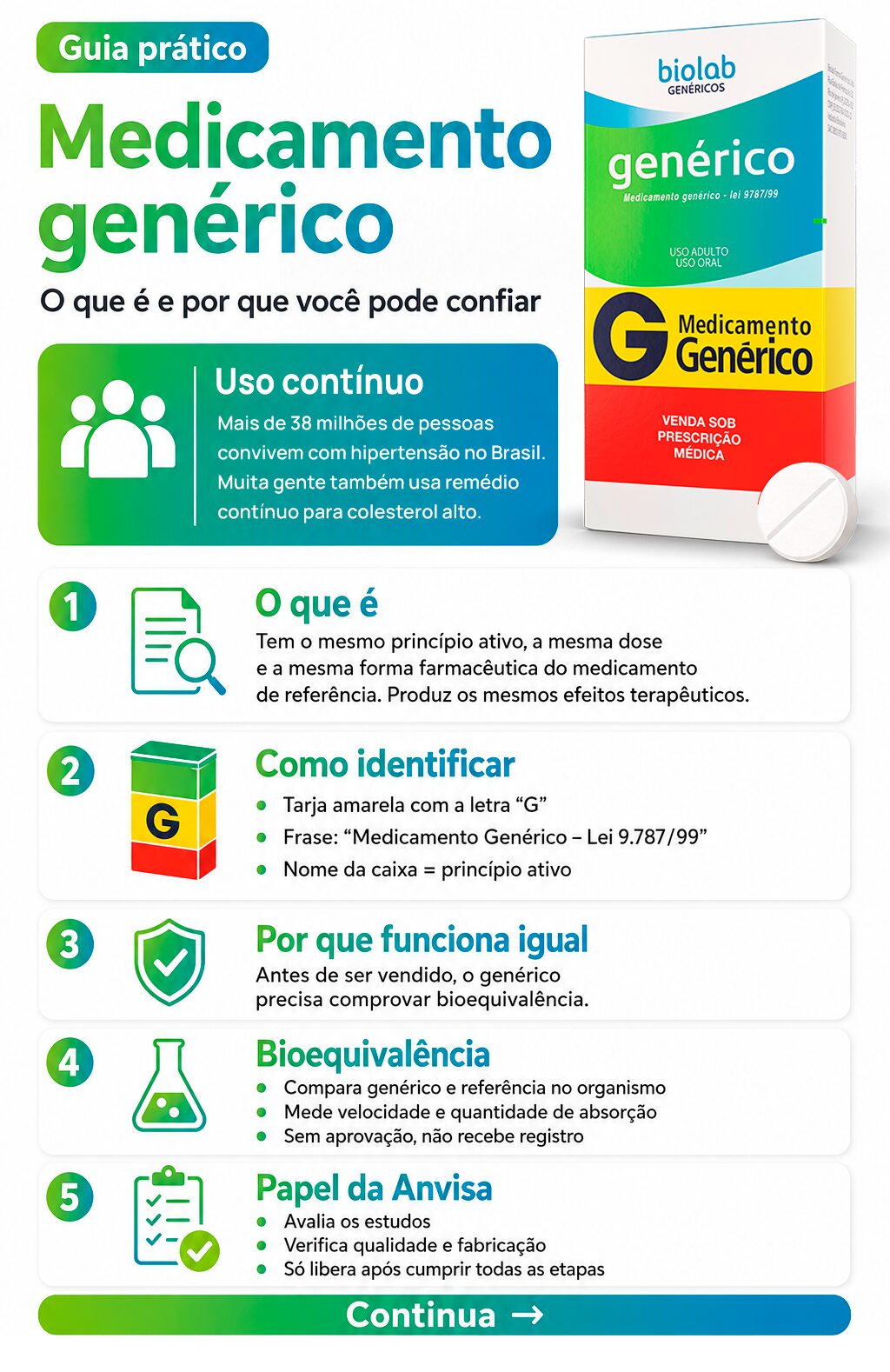
A generic drug is one that contains the same active ingredient, in the same dose and dosage form, as the reference drug. It is identified by the name of the active ingredient, not by a brand name. The Ministry of Health’s Virtual Health Library explains that the packaging of generic drugs bears the label “Generic Drug – Law 9.787/99” and a yellow stripe with the letter “G.”.
In practice, this means that, instead of being listed under a brand name, the medication is listed by the name of its active ingredient. Common examples of such identification include names such as “losartan potassium” or “simvastatin,” when these active ingredients are prescribed and available in generic form.
Trust in generic drugs does not depend on opinion or informal comparisons. According to Anvisa, the interchangeability between brand-name and generic drugs is ensured by therapeutic equivalence tests, which include pharmaceutical equivalence and bioequivalence studies submitted to the regulatory agency.
Therefore, the safest way to put it is not to say that a generic drug is “simpler” or “weaker.” The correct way to describe it is that it is a regulated medication, registered with Anvisa and approved after meeting the applicable technical criteria for quality, equivalence, and safety.
How to Identify a Generic Drug at the Pharmacy
The visual identification of generic drugs is standardized to make them easier for consumers to recognize. According to the Ministry of Health’s Virtual Health Library, the packaging must always include the phrase “Generic Drug – Law 9.787/99” and a yellow stripe with the letter “G.”.
It is also important to check the name that appears on the package. For generic drugs, the main name refers to the active ingredient, not a brand name. This helps patients verify that the medication they receive at the pharmacy matches what was prescribed.
The Ministry of Health’s Virtual Health Library (BVS/MS) also states that pharmacies and drugstores must display, in a location easily visible to consumers, an updated list of available generic medications. If in doubt, the pharmacist is the qualified professional who can help identify the medication and clarify whether a substitution is possible.
Bioequivalence: What This Test Means
Bioequivalence is one of the most important concepts for understanding the reliability of generic drugs. Simply put, it is the study that compares how a generic drug and a reference drug behave in the body.
Anvisa defines bioequivalence as the demonstration of pharmaceutical equivalence between drugs presented in the same dosage form, containing an equivalent qualitative and quantitative composition of the active ingredient, and that have comparable bioavailability when studied under the same experimental design.
In simple terms, this means that the generic drug must demonstrate that the amount and rate of absorption of the active ingredient are comparable to those of the reference drug, within the required regulatory criteria. This is not merely a bureaucratic formality: it is a technical step in the registration process.
Therefore, it is best to avoid the statement “the generic drug delivers exactly the same amount over the same period of time.” The more accurate way to phrase this is: the generic drug must demonstrate bioequivalence with the reference drug, in accordance with the criteria evaluated by Anvisa.
Brand-name, generic, and similar: What's the difference?
The reference drug is the product used as a benchmark for comparison. According to Anvisa, it is the innovative drug registered in the country, whose efficacy, safety, and quality were verified by the agency at the time of registration.
A generic drug has the same active ingredient, dosage, dosage form, and route of administration as the reference drug. It is identified by the name of the active ingredient and must demonstrate equivalence to the reference product in order to obtain registration.
A similar drug may also contain the same active ingredient, dose, dosage form, and route of administration, but is identified by its trade name or brand name. According to Anvisa, consulting the list of similar drugs allows users to verify which products are interchangeable with a reference drug.
The difference, therefore, lies not only in the price or the appearance of the packaging. It lies in the labeling, the regulatory framework, and the rules governing interchangeability. If in doubt, a pharmacist can help determine whether the substitution is appropriate.
Anvisa's Role in the Approval of Generic Drugs
No generic drug should be treated as a mere copy without evaluation. Before it reaches the pharmacy, it must be registered with Anvisa and meet technical requirements.
According to Anvisa, generic drugs were introduced in Brazil under Law No. 9,787/1999. The agency also states that interchangeability with the reference drug depends on therapeutic equivalence testing, including pharmaceutical equivalence and bioequivalence.
Anvisa also maintains public databases for searching approved medications, which allow users to verify information about registered products. This transparency is important so that healthcare professionals, patients, and consumers have access to official information.
Confidence in generic drugs, therefore, stems from a combination of factors: legislation, health registration, technical evaluation, required testing, and regulatory oversight. It is neither a promise from the manufacturer nor a choice based solely on price.
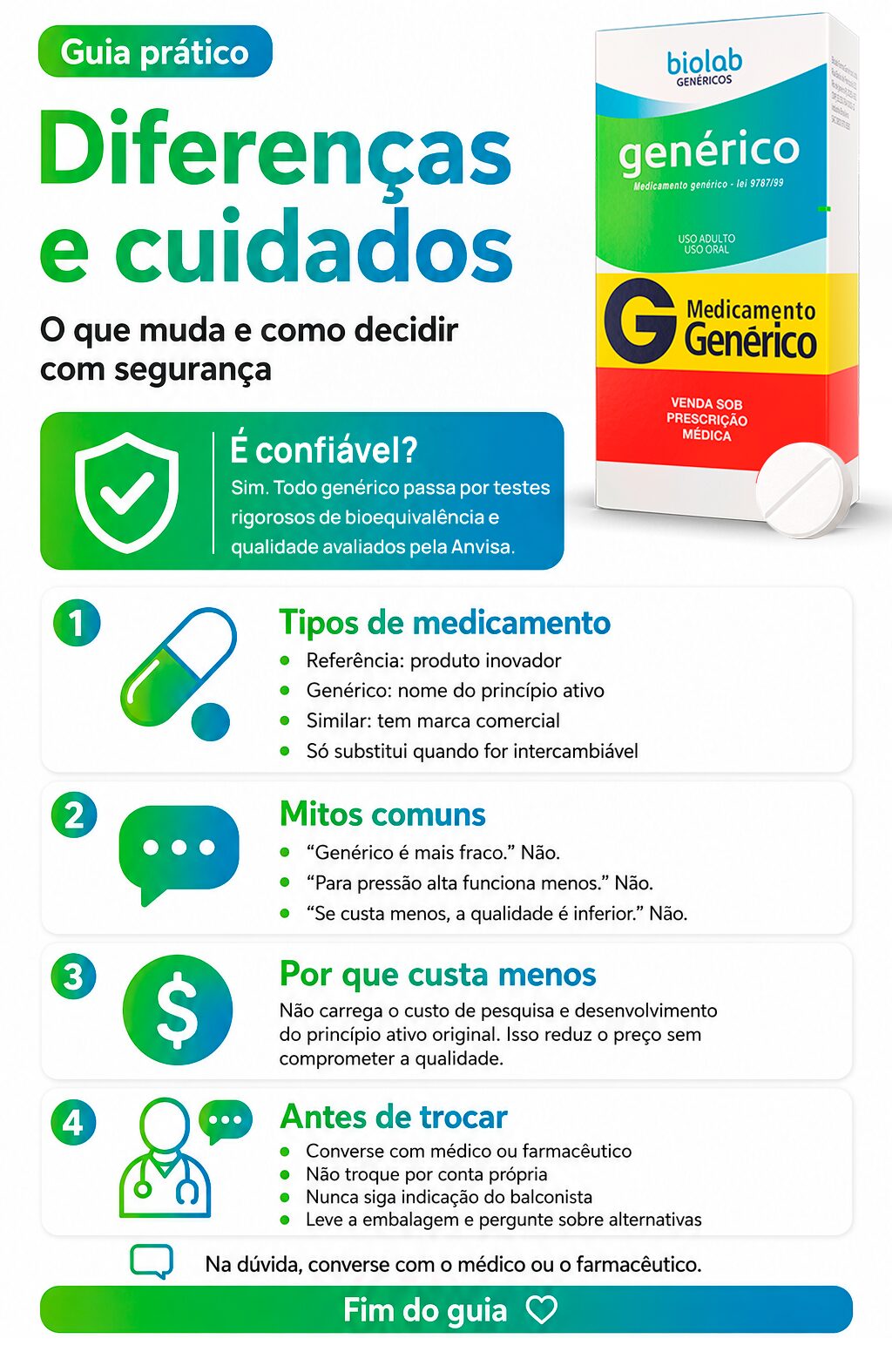
Common Myths About Generic Drugs
Some questions about generic drugs remain common, especially among people who take medication on a regular basis. Below are some points that warrant clarification.
“Generic drugs are less effective.”
That is not the regulatory definition. A generic drug must demonstrate equivalence to the reference drug, in accordance with the criteria required by Anvisa. This includes studies of pharmaceutical equivalence and bioequivalence.
“Generic medications for high blood pressure or high cholesterol aren’t as effective.”
Generic drugs used in different therapeutic areas must meet the applicable regulatory criteria before receiving approval. The individual response to treatment, however, should be monitored by a physician, especially in chronic conditions such as hypertension and dyslipidemia.
“If it costs less, the quality is lower.”
A lower price does not, in and of itself, mean lower quality. According to the BVS/MS, generic drugs can be sold at a lower price because they do not involve the same initial development costs as the reference drug. Even so, they must meet regulatory criteria to be approved.
“Anyone at the pharmacy can fill my prescription.”
No. Guidance on medication substitution must involve a licensed healthcare professional. The BVS/MS highlights the role of physicians and pharmacists in the use of generic drugs. Patients should not substitute medications on their own or change the dose, schedule, or frequency without guidance.
Why do generic drugs usually cost less?
A common misconception is to assume that a lower price means lower quality. This assumption is incorrect.
The reference drug is developed based on initial research, clinical studies, and the registration processes associated with the innovative product. After the patent protection period expires and in accordance with regulatory rules, other pharmaceutical companies may produce generic drugs containing the same active ingredient, provided they meet the required standards.
According to BVS/MS, generic drugs may be cheaper because they do not have to repeat the entire research investment made for the reference drug. This difference can lower the final price for consumers, without eliminating the need to demonstrate quality and equivalence to Anvisa.
For those who take medication on a regular basis, cost is an important consideration. However, the choice must be made safely, following the prescription, dosage, dosage form, and the advice of the doctor or pharmacist.
When talking to your doctor or pharmacist
Discussions about generic drugs should be part of patient care, especially for those who take medication every day. The doctor is the professional who evaluates the treatment based on the diagnosis, test results, the patient’s medical history, and other medications the patient is taking.
At the pharmacy, the pharmacist can provide guidance on identifying the generic name, active ingredient, dosage, form, instructions for use, and the possibility of substitution. This support is important for avoiding confusion between brand name, active ingredient, generic name, similar drug, and reference drug.
The BVS/MS notes that, within the Unified Health System, prescriptions must use the generic name. In the private sector, patients may also discuss with their doctor the inclusion of the active ingredient on the prescription when there is uncertainty or a need to facilitate identification.
If you take medication for high blood pressure, high cholesterol, or another chronic condition, bring any questions you have to your doctor’s appointment or to your pharmacist. Do not stop taking your medication, do not change the dose, and do not substitute medications on your own.
Frequently Asked Questions About Generic Medications
What is a generic drug?
It is a drug identified by its active ingredient and regulated by Anvisa. It must contain the same active ingredient, dose, and dosage form as the reference drug and demonstrate equivalence in accordance with the criteria required for registration.
Are generic drugs reliable?
When registered with Anvisa, the generic drug has undergone regulatory review and must have demonstrated equivalence to the reference drug in accordance with the agency’s requirements. If you have any questions about a specific product, you can consult Anvisa’s official information or ask your pharmacist for guidance.
What is the difference between a generic drug and a similar drug?
Generic drugs are identified by the name of the active ingredient and by the yellow label bearing the letter “G.” Brand-name drugs have a trade name or brand name. According to Anvisa, the interchangeability of brand-name drugs must be verified through the agency’s online search systems.
Why are generic drugs cheaper?
Generally speaking, because it does not need to repeat the entire initial development process of the reference drug. Even so, it must meet regulatory requirements for quality and equivalence in order to be registered.
Can I switch to a generic version of my blood pressure medication?
It may be possible, provided that the substitution follows the prescription and is guided by a doctor or pharmacist. Do not substitute medications on your own, especially for ongoing treatments.
How can you identify a generic medication package?
According to BVS/MS, the packaging of the generic drug bears the phrase “Generic Drug – Law 9.787/99” and a yellow stripe with the letter “G.” The main name on the box corresponds to the active ingredient.
Does a generic cholesterol medication work the same as the brand-name version?
A generic drug must demonstrate equivalence to the reference drug in accordance with Anvisa’s regulatory criteria. The individual’s response to treatment should be monitored by a physician, based on test results, symptoms, medical history, and adherence to proper use.