













Warning Signs in Children: When to See the Pediatrician Right Away
Fever, unusual breathing, refusal to eat, vomiting, diarrhea, or a significant change in behavior can be cause for concern for any family. These are warning signs in children that deserve attention because they are not always able to explain how they feel.
This content provides general guidelines based on references from the Brazilian Society of Pediatrics, Fiocruz, the Ministry of Health, and international health organizations. The goal is to help families recognize situations that require a pediatric evaluation, without replacing the consultation, diagnosis, or treatment recommended by a healthcare professional.
Important note: This article is for informational purposes only. If you have any concerns about your child’s condition, if their symptoms worsen, or if you notice any signs of a serious condition, contact your pediatrician or the nearest healthcare provider.
Why Paying Attention to Warning Signs Makes a Difference
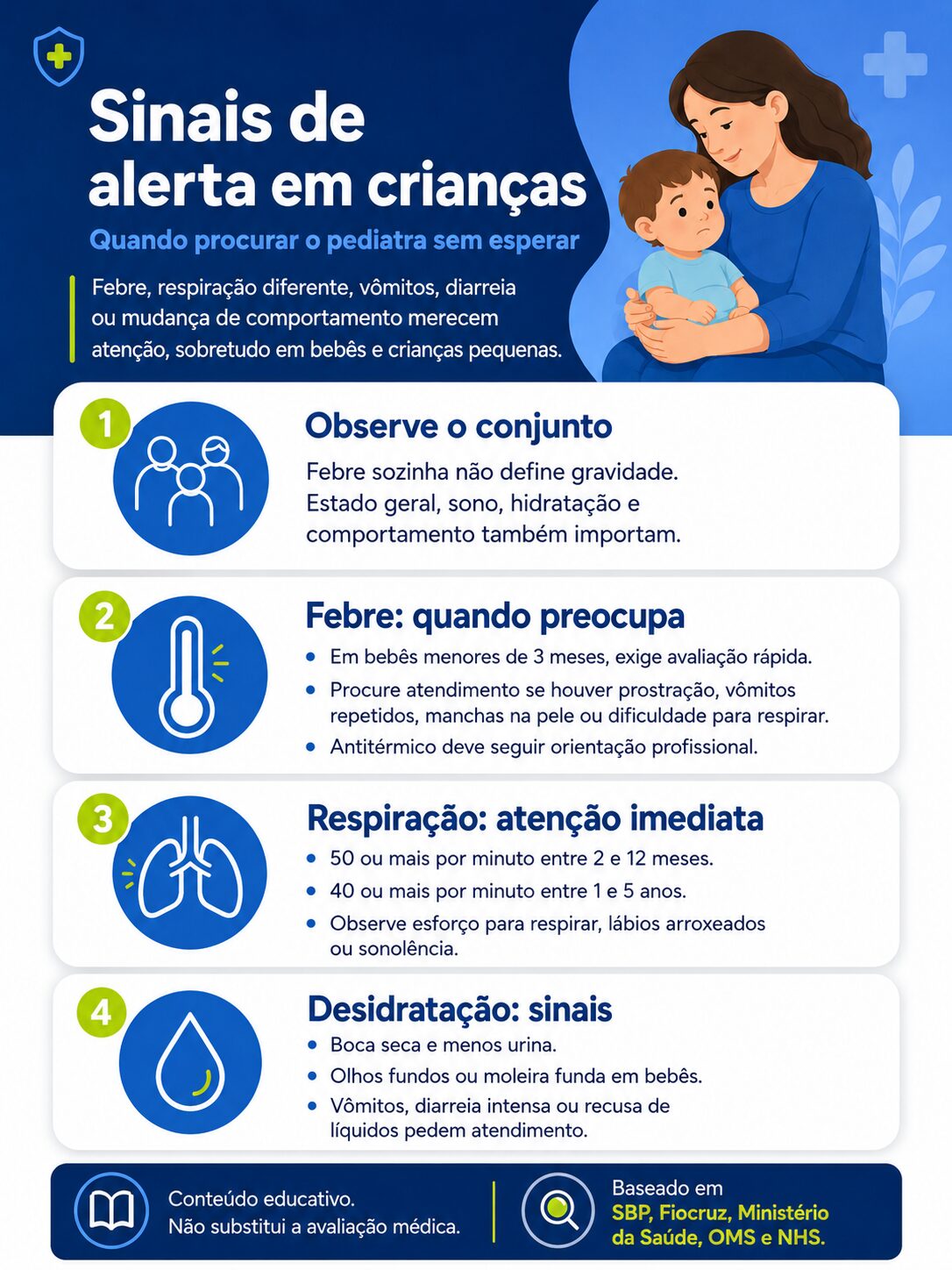
In infants and young children, changes in behavior can be just as important as the temperature reading on a thermometer. According to the Brazilian Society of Pediatrics, a fever should be evaluated in conjunction with the child’s overall condition, including activity level, hydration, comfort, sleep, feeding, and the presence of other symptoms.
A child with a fever who is active, well-hydrated, and interacting may be in a different situation than another child whose fever is accompanied by unusual drowsiness, persistent irritability, intense crying, refusal to eat, or difficulty breathing. Therefore, evaluating the full set of symptoms is more reliable than observing a single isolated sign.
Fever: When to Monitor and When to Seek Medical Care
Fever is the body’s response and can occur in viral and bacterial infections, as well as in other conditions. The Brazilian Society of Pediatrics emphasizes that the severity of a fever, on its own, should not be used as the sole indicator of severity, except in specific situations, such as in infants younger than 3 months.
Technical and educational materials provide different cut-off points for fever. Documents from the Brazilian Society of Pediatrics cite values that vary depending on the measurement method and context, such as an axillary temperature above 37.3 ºC, 37.5 ºC, or 37.8 ºC. Therefore, to avoid any uncertainty, the safest approach is to consider the temperature in conjunction with the child’s behavior, age, hydration status, and other symptoms.
Seek medical evaluation immediately if a fever occurs in infants younger than 3 months, when it persists, or when it is accompanied by signs such as lethargy, unusual drowsiness, severe irritability, persistent crying, skin rashes, repeated vomiting, neck stiffness, difficulty breathing, or a worsening of the child’s overall condition. According to the Brazilian Society of Pediatrics, the use of fever-reducing medication should take the child’s discomfort into account, and medication should not be used as an automatic response to the thermometer reading. All medication should be administered under professional guidance, especially in young infants.
Changes in breathing that warrant attention
Difficulty breathing is a symptom that must be closely monitored. According to integrated child health care guidelines used by the Ministry of Health and the World Health Organization, rapid breathing for the child’s age, chest retractions, stridor at rest, cyanosis, and other general warning signs may indicate the need for urgent evaluation.
In children aged 2 to 12 months, rapid breathing is generally defined as 50 breaths per minute or more. Between 12 months and 5 years of age, the threshold is 40 breaths per minute or more. The count should be taken, whenever possible, while the child is at rest.
In addition to respiratory rate, watch for signs of distress, such as rib retraction during breathing, flaring of the nostrils, grunting, difficulty feeding or speaking, purplish lips, marked pallor, or drowsiness. If any of these signs are present, seek medical attention immediately.
Dehydration in Infants and Children: How to Recognize It
Dehydration can occur when a child loses more fluids than they can replace, especially in cases of vomiting, diarrhea, fever, or low fluid intake. According to the NHS, infants and children are among the groups at highest risk of dehydration.
Signs to watch for include a dry mouth, lips, or tongue; reduced urine output; fewer wet diapers than usual; no tears or reduced tear production when crying; sunken eyes; a sunken fontanelle in infants; drowsiness; irritability; or unusual tiredness.
Hydration should be tailored to the child’s age and clinical condition. In cases of repeated vomiting, severe diarrhea, refusal to drink fluids, drowsiness, difficulty waking up, rapid breathing, or signs of worsening condition, seek medical care. Younger children, especially infants, should be evaluated with greater caution.
Behavioral changes, persistent crying, and refusal to eat
Not every warning sign appears as a number. Sometimes, the main change is in behavior. The child may become more sleepy, less responsive, persistently irritable, cry intensely, or show less interest in playing, breastfeeding, or eating.
Fiocruz, when addressing fever in the pediatric emergency department, highlights signs of severity such as low fluid intake, lethargy, irritability, drowsiness, vomiting, cough, shortness of breath, and changes in perfusion. According to the Ministry of Health’s AIDPI (Integrated Care for Common Childhood Illnesses) manual, these signs should be evaluated together, especially when there is a fever or progressive worsening of symptoms:
- significant refusal to eat
- abnormal lethargy/drowsiness
- trouble waking up
- repeated vomiting
- seizures
- difficulty breathing
- intercostal retraction (ribs moving in and out with each breath)
- signs of dehydration
- deterioration in overall condition
This list is not a substitute for a medical evaluation. When in doubt—especially with young infants—it is safest to seek professional advice.
What to Keep in Mind Before Talking to the Pediatrician
Whenever possible, write down any information that might help your healthcare provider:
- the child's age;
- temperature measured and measurement location;
- time when symptoms began;
- presence of fever, vomiting, diarrhea, cough, or difficulty breathing;
- amount of fluids consumed;
- number of wet diapers or trips to the bathroom;
- the child's behavior;
- medications taken, including dosage and schedule;
- pre-existing conditions, allergies, and vaccination status.
This information helps you communicate effectively with your pediatrician, but it should not delay seeking medical care when there are signs of a serious condition.
Frequently Asked Questions About Warning Signs in Early Childhooda
Learn about some signs that warrant attention and find out when to seek a pediatric evaluation, based on guidelines from the SBP, Fiocruz, the Ministry of Health, the WHO, and the NHS.
Is a fever in a newborn serious?
Fever in newborns and young infants should be evaluated with caution. For infants under 3 months of age, the Brazilian Society of Pediatrics recommends paying special attention, as fever may be one of the few signs of serious infections in this age group. In such cases, seek medical evaluation on the same day.
When should you take your child to the emergency room because of a fever?
Seek medical care if the fever is accompanied by unusual drowsiness, severe irritability, persistent crying, difficulty breathing, repeated vomiting, skin rashes, a stiff neck, signs of dehydration, or a worsening of the child’s overall condition. For infants younger than 3 months, evaluation should be done more promptly.
What are the respiratory warning signs in children?
Rapid breathing for the child’s age, labored breathing, visible ribs, flaring nostrils, grunting, purplish lips, difficulty breastfeeding or speaking, and drowsiness associated with respiratory symptoms are signs that warrant a medical evaluation.
My baby won't eat: when should I be concerned?
Concerns increase when a baby consistently refuses to eat, is unable to breastfeed, or experiences repeated vomiting, fever, diarrhea, fewer wet diapers, drowsiness, or significant irritability. In these cases, seek pediatric advice.
Child breathing rapidly: what should you do?
Count the number of breaths per minute while the child is at rest, if this can be done without delaying care. According to the World Health Organization (WHO), in the classic guidelines for the integrated management of common childhood illnesses, the cutoff points for rapid breathing are defined by age group: in children aged 2 to 12 months, 50 breaths per minute or more is a warning sign. Between 12 months and 5 years of age, 40 breaths per minute or more warrants attention. If there is labored breathing, bluish lips, drowsiness, or a worsening of the child’s general condition, seek medical care immediately.
If you have any questions, consult your doctor.