














The Difference Between Generic and Similar Drugs: What Prescribers Need to Know About Bioequivalence, Regulation, and Therapeutic Choice
The supply of generic and similar drugs in Brazil is regulated by the National Health Surveillance Agency (Anvisa) and involves specific criteria for registration, technical validation, and interchangeability. For prescribing physicians, understanding the differences between generic and similar drugs helps them advise patients more confidently, reduce confusion at the time of dispensing, and ensure that prescriptions comply with current health regulations.
The distinction between reference drugs, generics, and similar drugs is not limited to the brand name or price. It involves the type of evidence required, how the product is identified, and the conditions under which substitution may occur at the pharmacy. According to Anvisa, the interchangeability of generics with reference drugs is ensured by therapeutic equivalence tests, including pharmaceutical equivalence and bioequivalence. In the case of similar drugs, however, substitution depends on their specific classification as interchangeable similar drugs.
This guide outlines the key concepts to support clinical practice and communication with patients, without replacing the prescriber’s individualized assessment or applicable health regulations.
Why Does This Distinction Matter in Clinical Practice?
The difference between reference drugs, generic drugs, and similar drugs determines which products can be substituted during dispensing, which require attention to the brand name, and which depend on checking their interchangeability status.
For the prescriber, this distinction is important for three main reasons: it helps determine which medication can be dispensed to the patient in the event of a substitution; it makes it easier to explain generics and similar drugs in an accessible way; and it helps the prescriber note on the prescription when there is a clinical reason to continue prescribing a specific product.
Dispensing also plays an important role in this process. According to the World Health Organization (WHO), the rational use of medicines requires that patients receive medicines appropriate to their clinical needs, in the correct doses, for as long as necessary, and at the lowest possible cost to them and the community. The FIP/WHO Guidelines on Good Pharmaceutical Practices also emphasize that pharmacists should provide patients with adequate information, support the correct use of medications, and contribute to treatment safety.
Reference drug: the regulatory starting point
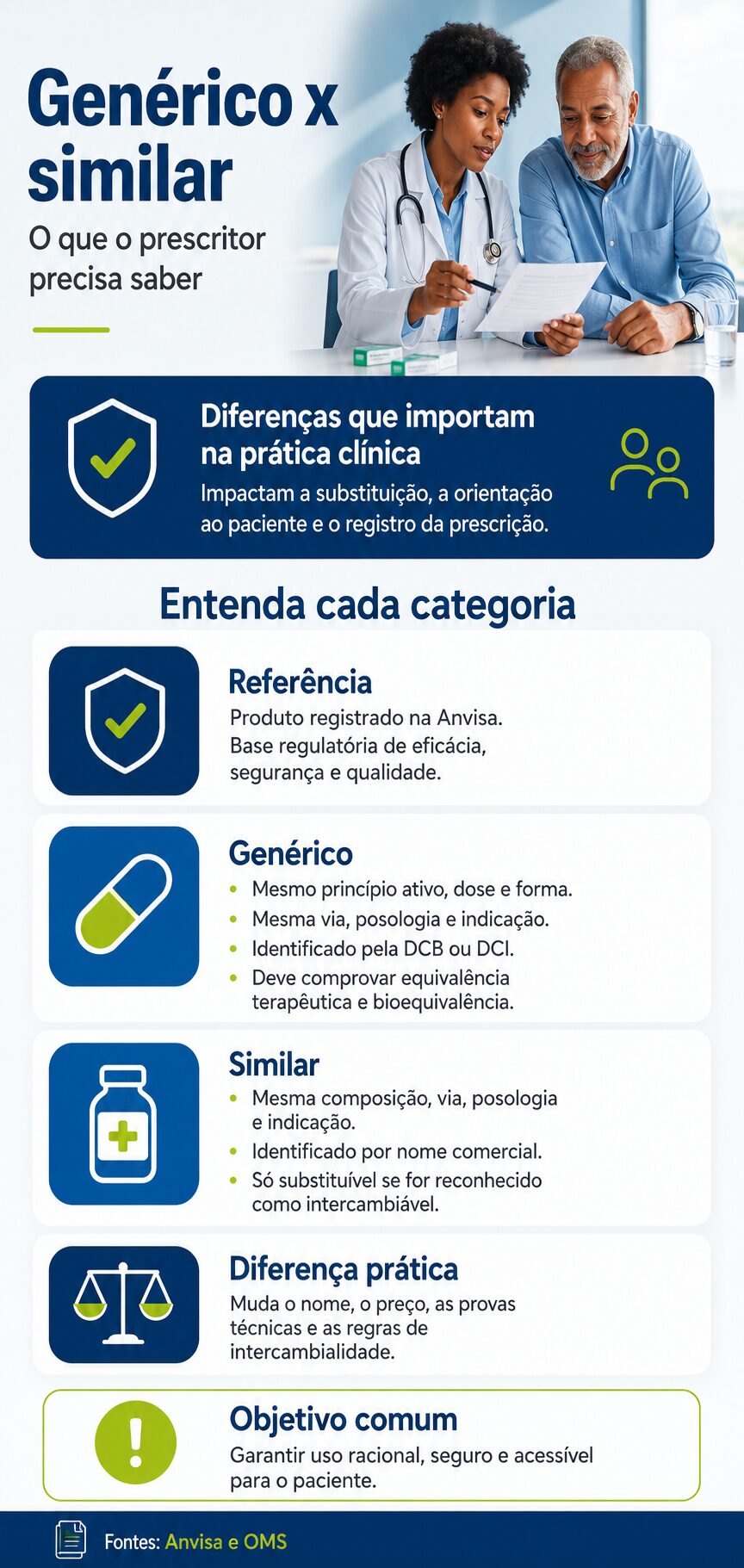
A reference drug is a product registered with Anvisa that serves as a benchmark for comparison with generic and similar drugs. It functions as a regulatory benchmark for efficacy, safety, and quality, so that other drugs can demonstrate comparable performance.
Anvisa maintains a List of Reference Drugs, which is updated periodically, to guide the registration of generic and similar drugs in the country. RDC No. 957/2024 establishes criteria and procedures for the designation, inclusion, and exclusion of drugs from this list. Therefore, the reference drug serves as the basis against which it is assessed whether a generic or similar drug meets the required technical criteria.
Generic drugs: bioequivalence criteria
According to Anvisa, a generic drug contains the same active ingredient, in the same dose and dosage form, is administered by the same route, and has the same dosage regimen and therapeutic indication as the reference drug. It is identified by the Brazilian Common Name (DCB) or, when none exists, by the International Nonproprietary Name (INN), and not by a brand name.
To obtain approval, a generic drug must demonstrate therapeutic equivalence with the reference drug. This demonstration includes in vitro tests, such as pharmaceutical equivalence, and in vivo bioequivalence studies, in accordance with applicable regulatory criteria.
RDC No. 742/2022 sets forth the criteria for conducting relative bioavailability/bioequivalence studies and pharmacokinetic studies. Broadly speaking, these studies evaluate parameters such as Cmax, Tmax, and AUC, which indicate, respectively, the maximum concentration reached, the time to reach it, and the extent of drug absorption over time.
In practice, when a generic drug is approved, Anvisa acknowledges that it has demonstrated performance comparable to that of the reference drug within the required regulatory criteria. This allows for its interchangeability with the reference drug, subject to the conditions of prescription and dispensing.
Generic Drugs: What Has Changed in the Regulations
A generic drug contains the same active ingredient as the brand-name drug, in the same concentration, dosage form, route of administration, dosage, and therapeutic indication. The difference is that it is identified by its trade name or brand name.
Historically, generic drugs were not subject to the same set of requirements for demonstrating therapeutic equivalence that currently apply to this category. Starting with RDC No. 134/2003, Anvisa began requiring that generic drugs demonstrate safety, efficacy, and quality, including comparative studies with the reference drug.
According to Anvisa, not all generic drugs can be substituted for the reference drug. Only generic drugs that have undergone the required comparative testing and have been recognized as interchangeable may be substituted at the time of dispensing. These products can be found in Anvisa’s drug database, and information regarding interchangeability must also appear on the package insert with the phrase “Generic drug equivalent to the reference drug.”.
Bioequivalence, relative bioavailability, and bioexemption
Bioequivalence and relative bioavailability are closely related concepts, but they have specific regulatory frameworks. According to Anvisa, bioavailability refers to the rate and extent of absorption of an active ingredient from a pharmaceutical formulation. In other words, it describes how much of the drug reaches the systemic circulation and at what rate.
Bioequivalence is the demonstration that two pharmaceutical products, in the same dosage form and with equivalent active ingredient composition, have comparable bioavailability when evaluated under the same experimental design. This is the test required for generic drugs.
Relative bioavailability compares the pharmacokinetic profile of a test product—such as a biosimilar—with that of a reference drug. The study evaluates similar parameters, but the regulatory framework is different.
RDC No. 749/2022 addresses bioexemption, that is, the waiver of bioequivalence or relative bioavailability studies in specific situations. This waiver does not mean there is no technical evaluation. According to Anvisa, bioexemption depends on compliance with regulatory criteria, which may involve the pharmaceutical form, route of administration, site of action, proportionality between concentrations, dissolution profile, and, in some cases, the Biopharmaceutical Classification System (SCB). Therefore, when applicable, bioexemption is a regulatory pathway contingent upon technical justifications and evidence.
Interchangeability in Practice
Interchangeability is the regulatory option to substitute one medication for another during dispensing, in accordance with public health regulations and the terms of the prescription.
In the case of generic drugs, Anvisa states that the replacement of the brand-name drug with the corresponding generic drug may be carried out by the responsible pharmacist, provided it is noted on the prescription. This option is based on proof of therapeutic equivalence.
In the case of generics, the situation requires a specific inquiry. According to Anvisa, a generic can only replace the reference drug when it is recognized as an interchangeable generic. The inquiry must be made in the Anvisa database, verifying the reference drug to which that generic is linked.
The substitution between a generic and a similar drug is not automatic. Anvisa clarifies that the tests submitted as part of the registration of generics and similar drugs are conducted in comparison with the reference drug, and not necessarily between the products themselves. Therefore, the substitution between a generic and a similar drug should not be treated as equivalent to the substitution between a reference drug and a generic or between a reference drug and an interchangeable similar drug.
How to Counsel the Patient
Questions such as “Can I use the generic version?” or “Is the generic drug the same as the brand-name one?” are common in the doctor’s office. The answer should be clear, objective, and free of generalizations.
A straightforward way to explain this is to say that a generic drug is approved by Anvisa after demonstrating therapeutic equivalence with the reference drug and, therefore, can be used interchangeably with it. A “similar” drug, on the other hand, is also compared to the reference drug, but its substitution depends on whether it is recognized as interchangeable by Anvisa.
It is also important to explain that packaging, brand name, form, color, and excipients may vary from one product to another. In some cases, these differences can cause confusion for patients and affect their adherence to treatment. Therefore, providing guidance at the time of prescribing and dispensing helps ensure the correct use of the medication.
When there is a clinical reason to continue using a specific product—such as a history of reaction to a particular excipient, difficulty adhering to treatment following previous changes, complex polypharmacy, or the use of medications that require closer monitoring—the decision should be made on a case-by-case basis and clearly documented on the prescription and in the medical record.
Situations That Require Extra Attention
Some situations may require greater caution when switching medications. This is the case for patients taking medications with a narrow therapeutic range, people with multiple comorbidities, patients on multiple medications, or people who have difficulty understanding changes in the drug’s name, packaging, or form.
These situations do not mean that generic or similar drugs are inappropriate. It simply means that the decision to continue using or substitute a product must take into account the clinical context, treatment stability, the patient’s understanding, and the applicable interchangeability rules.
Frequently Asked Questions
What is the difference between a generic drug and a similar drug?
A generic drug is identified by its DCB or DCI; it does not have a brand name and must demonstrate bioequivalence with the reference drug. A similar drug has a trade name or brand name and must meet applicable regulatory requirements, including comparative studies with the reference drug. The most important practical difference lies in interchangeability: a generic drug is interchangeable with the reference drug; a similar drug depends on specific recognition by Anvisa as an interchangeable similar drug.
Are generic and similar drugs equally effective?
This question requires a careful answer. Both are evaluated in comparison to the reference drug, but under different regulatory frameworks. The generic drug must demonstrate bioequivalence; the similar drug must meet the applicable requirements, such as relative bioavailability or, where applicable, bioequivalence criteria. It is not appropriate to assert an automatic hierarchy among these categories. The most important thing is to verify the registration, the indication, the reference product, and the interchangeability rules.
Can a pharmacist substitute the brand-name drug with a generic?
According to Anvisa, the replacement of the brand-name drug with the corresponding generic drug may be carried out by the pharmacist in charge of the pharmacy or drugstore, with a note made on the prescription, in accordance with applicable regulations.
Can a generic drug replace the brand-name drug?
It depends. Only similar drugs recognized as interchangeable by Anvisa may be used as substitutes for the corresponding reference drug. You should check Anvisa’s drug database.
What is bioexemption?
Bioexemption is the waiver of bioequivalence or relative bioavailability studies in specific situations provided for in RDC No. 749/2022. This waiver is based on technical and regulatory criteria and should not be interpreted as a lack of evaluation of quality, safety, or performance.
Conclusion
The difference between generic and similar drugs involves more than just nomenclature. It encompasses registration criteria, required studies, identification methods, and interchangeability rules. For prescribers, understanding these points helps them advise patients, reduce uncertainty at the time of dispensing, and properly document situations in which substitution should be evaluated with caution.
Generics and similar drugs are part of Brazil’s regulatory policy for medications, but they should not be treated as identical categories. The safest approach is always to consider the reference drug, the product’s regulatory status, up-to-date information from Anvisa, and the patient’s individual clinical context.