







Metabolic syndrome and cardiovascular risk: when pressure, cholesterol and glucose are measured at the same time
You get your annual check-up, get the results and realize that your blood pressure is a little high. Your cholesterol level didn’t come in as expected. Your fasting glucose level was borderline. Your triglycerides went up. Your waist circumference has increased. It’s time to pay attention to metabolic syndrome and cardiovascular risk factors.
Individually, each of these numbers may seem insignificant. But when they appear together, the situation requires more attention. According to the American Heart Association, metabolic syndrome is a set of conditions that, when combined, increase the risk of cardiovascular disease, stroke, type 2 diabetes, and other health problems.
The challenge is that many people receive these results and do not understand the magnitude of the combination. Each change seems too small to justify a change of course. The doctor mentions “metabolic syndrome,” but the term may sound technical and distant. Meanwhile, the cardiometabolic risk may evolve without obvious symptoms.
This article explains what metabolic syndrome is, what criteria are usually used in the diagnosis, why the combination of these factors deserves attention, and how diet, physical activity, sleep, and medical follow-up can help with preventive care.
What is metabolic syndrome?
Metabolic syndrome is not a single disease. It is a set of metabolic changes that occur simultaneously and increase the risk of cardiovascular diseases and type 2 diabetes. According to the American Heart Association, these changes include increased abdominal circumference, elevated triglycerides, low HDL, high blood pressure, and elevated fasting glucose.
In practice, the diagnosis functions as an integrated alert. Instead of evaluating each number individually, the healthcare professional observes the whole picture. According to the American Heart Association and the NHLBI/NIH, the presence of three or more of these criteria can characterize metabolic syndrome.
The five diagnostic criteria
The criteria may vary depending on the adopted guideline, the population evaluated, and the individual clinical analysis. Nevertheless, frequently used values include:
Increased abdominal circumference: above 102 cm in men or 88 cm in women.
High triglycerides: 150 mg/dL or more, or use of medication for control.
Low HDL: below 40 mg/dL in men or 50 mg/dL in women, or use of medication for control.
Elevated blood pressure: 130/85 mmHg or higher, or use of antihypertensive medication.
Elevated fasting glucose: 100 mg/dL or more, or use of a medication to control blood glucose.
These numbers should not be interpreted as a diagnosis in isolation. They serve as a reference for discussion with the doctor, who should consider family history, age, weight, waist measurement, blood pressure, laboratory tests, and other risk factors.
Why does the combination increase the risk?
Each risk factor can affect the body in different ways. High blood pressure can overload the heart and blood vessels. Altered lipid profile can favor the formation of plaques in the arteries. High glucose can indicate insulin resistance or higher risk of diabetes. Increased abdominal circumference can reflect greater accumulation of visceral fat.
When these factors appear together, the cardiovascular risk profile tends to be higher than when each change is observed separately. Reviews published in the NCBI Bookshelf/NIH and in PubMed Central/NIH indicate that the metabolic syndrome is associated with approximately twice the risk of atherosclerotic cardiovascular disease and a higher risk of type 2 diabetes, compared to people without the syndrome.
Therefore, the metabolic syndrome should be understood as a warning sign. It does not mean that a cardiovascular event will occur, but it indicates that there are modifiable factors that deserve monitoring and intervention.
How to interpret your exams with this integrated perspective
When receiving a check-up, it is common to look at each result individually: cholesterol, glucose, triglycerides, blood pressure. This reasoning is understandable, but it may be insufficient when several markers are close to or above the reference ranges.
During the consultation, it is worth paying close attention to the following:
- abdominal circumference;
- triglycerides;
- HDL;
- fasting glucose;
- blood pressure.
If three or more markers are abnormal, talk to your doctor about the possibility of metabolic syndrome and about a follow-up plan. Interpretation should be individualized, because goals and behaviors change based on each person’s cardiovascular risk.
The role of abdominal fat
The abdominal circumference is an important marker because it can indicate the accumulation of visceral fat, that is, fat localized around the internal organs. According to the NHLBI/NIH, excess body fat can contribute to inflammation, insulin resistance, high blood pressure, and changes in the heart and blood vessels.
This does not mean that the waist measurement alone determines the diagnosis. It is one of the five criteria used in the evaluation. A person can have an BMI within the normal range and still have accumulation of abdominal fat and other altered markers. Therefore, the physical examination and laboratory tests should be evaluated together.
Practical changes that can help
Metabolic syndrome is strongly linked to modifiable factors. According to the American Heart Association, many measures of care involve weight loss when indicated, increased physical activity, cardioprotective nutrition, and monitoring of glucose, cholesterol, and blood pressure with the healthcare team.
These changes do not replace medical evaluation, but they can help reduce the number of altered criteria and improve cardiometabolic risk over time.
Food
The focus does not need to be a restrictive or trendy diet. The safest recommendation is to prioritize a balanced diet, with greater presence of unprocessed or minimally processed foods and lower consumption of ultraprocessed foods.
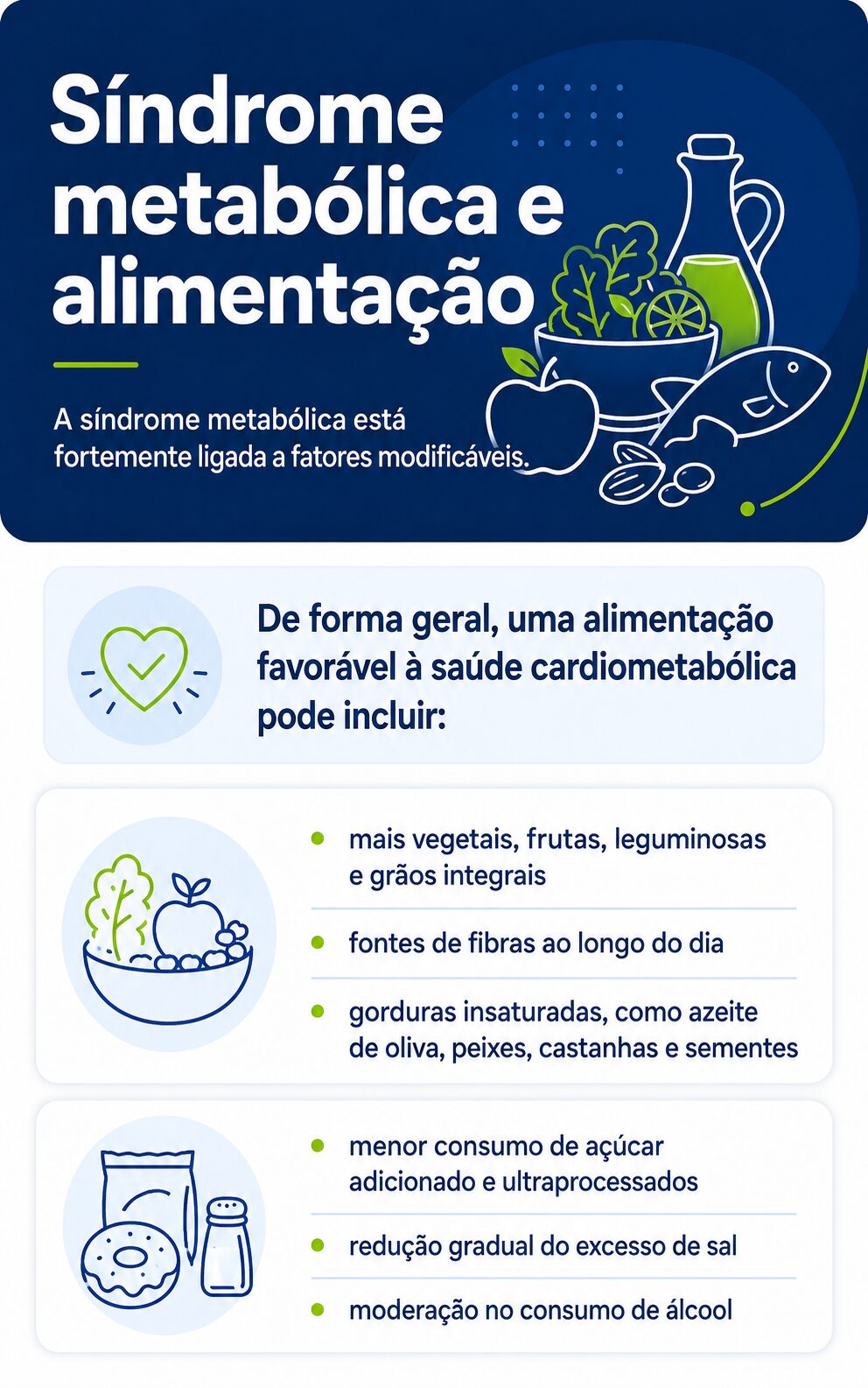
In general, a diet that is beneficial for cardiometabolic health can include:
- more vegetables, fruits, legumes and whole grains;
- fiber sources throughout the day;
- unsaturated fats, such as olive oil, fish, nuts and seeds;
- lower consumption of added sugar and ultraprocessed foods;
- gradual reduction of excess salt;
- moderation in alcohol consumption.
These guidelines should be adapted to the individual's reality, especially in cases of diabetes, hypertension, kidney disease, previous cardiovascular disease, or the use of medications.
Physical activity
The American Heart Association recommends that adults do at least 150 minutes per week of moderate aerobic activity or 75 minutes of vigorous activity, preferably distributed throughout the week. The organization also recommends muscle-strengthening activities on at least two days per week.
In practice, this may mean walking several days a week, including strength exercises and reducing long periods of sitting. The key point is not to do everything at once, but to build in regularity. For sedentary people with symptoms or with risk factors, the start of physical activity should be guided by a healthcare professional.
Sleep and Recovery
Insufficient or poor-quality sleep is associated with poorer cardiovascular and metabolic health and problems such as high blood pressure, type 2 diabetes, and obesity. Adequate sleep should be viewed as part of care, along with nutrition, physical activity, and professional follow-up.
When medications come into play
Changes in lifestyle are important, but they are not always enough. Depending on the results, the clinical history and the cardiovascular risk, the doctor may prescribe medications to control blood pressure, cholesterol, triglycerides or glucose.
The safest thing is to avoid closed lists of medications in the text, because the therapeutic choice depends on individual assessment. The reader should be advised not to start, interrupt or change medications on their own. In case of doubts about generics, similar products or specific brands, the conversation should be conducted with a doctor or pharmacist.
The check-up as a tool for prevention
Metabolic syndrome may not cause pain or obvious symptoms. Its identification depends on the combined assessment of waist circumference measurements, blood pressure, and laboratory tests. Therefore, the check-up should not be seen only as confirmation that “everything is fine,” but as an opportunity to identify trends and take action before the risk increases.
The frequency of the tests should be determined by the doctor. People with risk factors, family history, high blood pressure, changes in glucose levels, high cholesterol or already diagnosed metabolic syndrome may need closer monitoring.
Frequently asked questions about metabolic syndrome
Is metabolic syndrome curable?
The term “cure” is not the most appropriate. In some cases, consistent changes in lifestyle, weight loss when indicated, and treatment of the altered factors can cause the person to no longer meet the criteria for metabolic syndrome. Nevertheless, follow-up should continue, because the risk factors may change again.
What is the difference between metabolic syndrome and diabetes?
Metabolic syndrome is a set of risk factors. High glucose is one of the criteria, but the syndrome is not limited to that. Type 2 diabetes is a specific disease characterized by persistent changes in blood glucose. A person can have metabolic syndrome without having diabetes, but the syndrome increases the risk of developing type 2 diabetes.
Can thin people have metabolic syndrome?
Yes. Weight is not the only relevant factor. A person with an BMI within the normal range may have increased abdominal fat, elevated triglycerides, low HDL, high blood pressure, or altered glucose levels. Therefore, measuring waist circumference and laboratory tests are important.
How often should I repeat the tests?
The frequency should be determined by the physician, based on age, family history, previous results, the presence of risk factors, and treatments in use. In people with metabolic syndrome or altered markers, monitoring may need to be more frequent.
Does light physical activity make a difference?
It can be part of a strategy to reduce sedentary behavior. Walking more, using stairs, and breaking up long periods of sitting are useful behaviors, especially when combined with a regular routine of physical activity. To reduce cardiometabolic risk, the American Heart Association recommends combining aerobic activity and muscle strengthening throughout the week.
Important: This content is for educational purposes only and does not replace consultation, diagnosis, or medical treatment. In case of changes in blood pressure, cholesterol, triglycerides, glucose, or waist circumference, consult a healthcare professional.
References consulted
American Heart Association. What is Metabolic Syndrome?
https://www.heart.org/en/health-topics/metabolic-syndrome/about-metabolic-syndrome
Access on: 12 Aug 2026.
American Heart Association. Symptoms and Diagnosis of Metabolic Syndrome.
https://www.heart.org/en/health-topics/metabolic-syndrome/symptoms-and-diagnosis-of-metabolic-syndrome
Access on: 12 Aug 2026.
American Heart Association. Your Risk for Metabolic Syndrome.
https://www.heart.org/en/health-topics/metabolic-syndrome/your-risk-for-metabolic-syndrome
Access on: 12 Aug 2026.
National Heart, Lung, and Blood Institute / NIH. Metabolic Syndrome — Diagnosis.
https://www.nhlbi.nih.gov/health/metabolic-syndrome/diagnosis
Access on: 12 Aug 2026.
National Heart, Lung, and Blood Institute / NIH. Metabolic Syndrome — Causes and Risk Factors.
https://www.nhlbi.nih.gov/health/metabolic-syndrome/causes
Access on: 12 Aug 2026.
NCBI Bookshelf / National Institutes of Health. Metabolic Syndrome.
https://www.ncbi.nlm.nih.gov/books/NBK459248/
Access on: 12 Aug 2026.
Grundy SM. The Metabolic Syndrome. PubMed Central / National Institutes of Health.
https://pmc.ncbi.nlm.nih.gov/articles/PMC5393149/
Access on: 12 Aug 2026.
American Heart Association. Recommendations for Physical Activity in Adults and Kids.
https://www.heart.org/en/healthy-living/exercise-and-physical-activity/fitness-basics/aha-recs-for-physical-activity-in-adults
Access on: 12 Aug 2026.
CDC. About Sleep.
https://www.cdc.gov/sleep/about/index.html
Access on: 12 Aug 2026.
CDC. About Sleep and Your Heart Health.
https://www.cdc.gov/heart-disease/about/sleep-and-heart-health.html
Access on: 12 Aug 2026.
https://www.nhlbi.nih.gov/health/overweight-and-obesity/symptoms
Access on: 22 Sept 2026
https://www.hcor.com.br/wp-content/uploads/2024/06/Manual_versao-final.pdf
Access on: 22 Sept 2026