













Myths and Facts About Generic Medications for People with Heart Conditions
In Brazil, high blood pressure is a common condition and requires ongoing monitoring in many cases. According to the Ministry of Health’s Epidemiological Bulletin, based on the 2019 National Health Survey, more than 38 million Brazilians aged 18 or older had been diagnosed with hypertension. For some of these individuals, treatment may involve generic medications taken on a regular basis, always as directed by a doctor.
When it’s time to renew a prescription, a common question arises: Should you accept generic drugs or not? This uncertainty stems from the fact that many people still associate lower prices with inferior quality or confuse generic drugs with other categories of products. However, in Brazil, generic drugs are regulated by Anvisa and must meet specific criteria for quality, safety, efficacy, and equivalence to the brand-name drug.
This content addresses the most common questions about generic medications in the context of cardiovascular health. The goal is to provide clear information, without replacing a conversation with your doctor or pharmacist. When treating high blood pressure, high cholesterol, or other cardiovascular conditions, any questions about switching medications, dosage, brand, or continuing treatment should be discussed with the healthcare professional managing your case.
Where do all these doubts about generic drugs come from?
Brazil’s Generic Drugs Law was enacted in 1999. Law No. 9,787 defined generic drugs and established the legal framework for their use, including the requirement to demonstrate bioequivalence to establish interchangeability.
Even after more than two decades, there is still confusion between reference drugs, generic drugs, and similar drugs. A reference drug is the innovative product registered with Anvisa and marketed in Brazil, whose efficacy, safety, and quality were scientifically proven at the time of registration. It serves as the benchmark for the registration of generic and similar drugs. A generic drug, according to Anvisa, contains the same active ingredient, in the same dose and dosage form, is administered by the same route, and has the same dosage regimen and therapeutic indication as the reference drug. The agency also states that it must demonstrate equivalent efficacy and safety and may be interchangeable with the reference drug.
The patient’s doubts, therefore, should not be treated as mere misinformation. In ongoing treatments, especially for chronic conditions such as high blood pressure and high cholesterol, it is understandable that any change might cause apprehension. The best approach is to turn that uncertainty into a question: understand the active ingredient, the dose, the dosage form, and the prescriber’s instructions.
Myth: A generic drug is a weaker version of the brand-name drug
This is one of the most common questions, but it does not align with the regulatory definition of a generic drug. According to Anvisa, a generic drug must contain the same active ingredient, in the same dose and dosage form as the reference drug, and must also have the same route of administration, dosage regimen, and therapeutic indication.
For a drug to be considered bioequivalent to the reference drug, it must meet the criteria established by regulatory agencies, demonstrating that it behaves similarly in the body. In Brazil, these criteria are defined in Anvisa’s RDC No. 742/2022, which addresses relative bioavailability and bioequivalence studies.
To demonstrate this bioequivalence, one of the criteria evaluated is the comparison between the test drug and the reference drug using statistical criteria defined by regulatory agencies. The range of 80% to 125% specified in RDC No. 742/2022 does not mean that the generic drug may have “20% less effect.” This is a statistical criterion applied to the comparison between the drugs, which also takes into account the inherent variability of the reference drug itself and the bioequivalence study. For the reader, the clear message is: a generic drug approved by Anvisa must demonstrate equivalence to the reference drug within the required regulatory criteria.
Myth: Switching from brand-name blood pressure medication to generic drugs can throw your treatment off track
People who take medication on a regular basis for high blood pressure or high cholesterol may feel uneasy about switching to a different product. This concern should be taken seriously, but it needs to be analyzed from a technical standpoint.
When it comes to generic drugs approved by Anvisa, the active ingredient, dose, dosage form, route of administration, dosage regimen, and therapeutic indication must correspond to those of the reference drug. This supports the possibility of interchangeability provided for under Brazilian regulations.
Even so, cardiovascular treatments require consistency and follow-up. In some cases, there may be individual factors to consider, such as sensitivity to excipients or the need for closer monitoring. Therefore, for ongoing treatments, it is prudent to inform your doctor or pharmacist of any changes and to report any changes you notice after the substitution. The main recommendation is not to stop treatment or adjust the dose on your own.
Myth: If generic drugs were any good, doctors wouldn't prescribe brand-name drugs
Prescribing by brand name does not, in and of itself, mean that the generic drug is inferior. It may result from prescribing habits, the healthcare professional’s familiarity with a particular product, the patient’s history of use, or the need to ensure continuity in specific situations.
From a regulatory standpoint, Anvisa defines a generic drug as one that is as effective and safe as the reference drug and can be used interchangeably with it.
If you have any questions about why a prescription was written under a brand name, the safest course of action is to talk to your doctor. Asking questions such as “Is there a medical reason why I should stick with this brand?” or “Can I use the corresponding generic?” can help make the decision clearer and more mutually agreed upon.
Fact: Every generic drug approved in Brazil must demonstrate bioequivalence
In Brazil, demonstrating bioequivalence is an essential part of the generic drug policy. Law No. 9,787/1999 already establishes bioequivalence as a necessary element for characterizing the interchangeability of generic drugs.
Bioequivalence compares the performance of the test drug with that of the reference drug in the body. Anvisa’s RDC No. 742/2022 addresses relative bioavailability and bioequivalence studies and defines technical criteria for this evaluation, including the so-called pharmacokinetic parameters — measures that indicate, in simplified terms, how much of the active ingredient reaches the bloodstream and how long it takes to do so — and acceptance intervals.
Simply put, this means that a generic drug is not approved merely because it lists the same active ingredient on its label. It must demonstrate performance comparable to that of the reference drug within defined regulatory criteria.
Fact: A lower price doesn't mean lower quality
The price difference between generic drugs and brand-name drugs often raises suspicion, but there are regulatory and economic reasons for it. Anvisa states that one of the advantages of generic drugs is that they expand access to lower-priced medications, since a generic drug must be at least 35% cheaper than the brand-name drug.
Anvisa itself also points out that generic drugs are associated with the availability of safe, effective, and high-quality products, in addition to ensuring access to lower-priced products.
For those who take medications on a long-term basis, price can influence treatment adherence. The key point is that cost savings should not result in treatment interruptions, informal substitutions, or unresolved questions. The choice should be in accordance with the prescription, professional guidance, and the regularity of treatment.
Myth: You can control blood pressure and cholesterol through diet alone, without medication
A balanced diet, physical activity, adequate sleep, and stress management are all part of cardiovascular care. However, these habits do not automatically replace prescribed medications.
High blood pressure is a chronic condition characterized by elevated blood pressure levels in the arteries, and the Ministry of Health explains that high blood pressure causes the heart to work harder to circulate blood properly throughout the body. Treatment and follow-up depend on an individual assessment.
In some cases, lifestyle changes can help control blood pressure and cholesterol. In others, medication is necessary. The decision to reduce, switch, or discontinue any medication should be made by a doctor, based on test results, clinical progress, and cardiovascular risk. The safest approach is to combine healthy habits with the prescribed treatment, not to substitute one for the other without medical guidance.
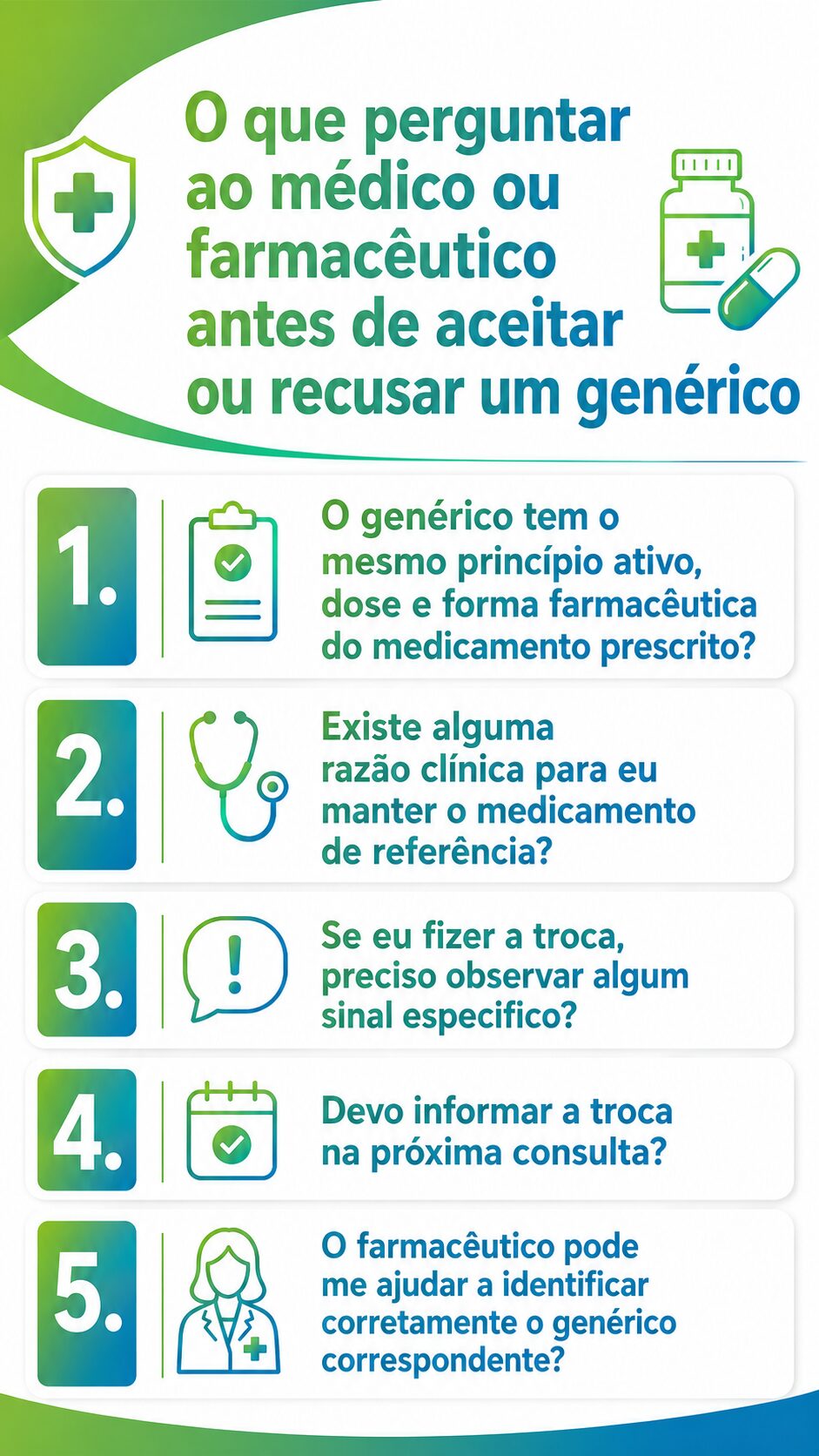
What to Ask Your Doctor or Pharmacist Before Accepting or Declining Generic Medications
According to the Ministry of Health, the best way to address questions about generic drugs is to bring up the topic during a doctor’s appointment or a consultation with a pharmacist. Here are some questions that may help:
- Does the generic drug have the same active ingredient, dosage, and dosage form as the brand-name drug?
- Is there any medical reason for me to continue taking the original medication?
- If I make the exchange, is there anything in particular I should look out for?
- Should I mention the change at my next appointment?
- Can the pharmacist help me correctly identify the corresponding generic drug?
These questions are not a sign of mistrust. They are part of an active and responsible approach to treatment. In cardiovascular care in particular, taking medication regularly and following up with a healthcare professional are just as important as choosing between brand-name, generic, or similar medications.
Frequently Asked Questions About Generic Drugs and Cardiovascular Health
Do generic drugs work the same as brand-name medications for high blood pressure?
A generic drug approved by Anvisa must demonstrate equivalence to the reference drug and contain the same active ingredient, dose, dosage form, route of administration, dosage regimen, and therapeutic indication. When treating high blood pressure, the switch must follow the prescription, and in case of doubt, should be discussed with a doctor or pharmacist.
Is it safe for people on long-term medication to switch to a generic version?
Brazilian regulations allow for the substitution of a generic drug when it is interchangeable with the reference drug. However, for ongoing treatments, it is recommended to inform your doctor or pharmacist about the switch and continue to follow up with them. Patients should not interrupt their treatment or adjust their doses on their own.
Is the quality of generic drugs regulated?
Yes. Anvisa is the authority responsible for the health regulation of drugs in Brazil. To be registered, generic drugs must meet regulatory requirements, including proof of equivalence and criteria for quality, safety, and efficacy.
Is there a generic version of cholesterol medication?
Generic drugs are available in Brazil for various active ingredients, including those used in cardiovascular treatments. Confirmation regarding a specific product should be obtained from a doctor or pharmacist, or by consulting Anvisa’s official databases.
Why does the generic drug cost less if it's equivalent to the brand-name drug?
According to Anvisa, a generic drug must cost at least 35% less than the reference drug. This is possible because generics are developed from an already known active ingredient and, therefore, do not need to repeat all the research and development stages carried out for the innovator drug. In addition, manufacturers do not need to invest in creating a new brand. This policy aims to expand the population’s access to treatments without compromising regulatory requirements for quality, safety, and equivalence.
Can I ask my doctor to switch me from a brand-name drug to a generic one?
Yes, you can discuss this possibility with your doctor. Your doctor is the one who can determine whether there is a clinical reason to continue taking the brand-name medication or whether the corresponding generic is appropriate for your situation. Your pharmacist can also provide guidance on identification, equivalence, and interchangeability in accordance with current regulations.
Important: This content is intended for educational and informational purposes only. It is not a substitute for consultation, diagnosis, prescription, or guidance from healthcare professionals. Never stop taking, change, or adjust your medications on your own.