







Obsessive-compulsive disorder: what are the symptoms, what is not OCD, and when is it worth seeking professional help
Obsessive-compulsive disorder, known by the acronym OCD, is a mental disorder characterized by recurring and unwanted thoughts called obsessions, repetitive behaviors or mental acts called compulsions, or both. According to the National Institute of Mental Health (NIMH), these obsessions and compulsions can consume time, cause significant distress and interfere with daily life.
Despite this, the term OCD is still used inaccurately in everyday life. Enjoying symmetry, preferring a tidy home or having an organized routine does not, by itself, mean having obsessive-compulsive disorder. The difference lies in the suffering, the loss of control, the time consumed by thoughts or rituals, and the impact on work, studies, relationships, sleep, and quality of life.
This content was created to help those who are researching symptoms of OCD understand what characterizes the disorder, what does not constitute OCD, how the disorder can affect daily life, and why searching the internet does not replace a clinical evaluation. The goal is educational, without the intent of diagnosis or prescription.
What is OCD?
Obsessive-compulsive disorder is characterized by the presence of obsessions, compulsions, or both. The NIMH defines OCD as a disorder marked by uncontrollable and recurring thoughts, repetitive and excessive behaviors, or both. The institution also reports that symptoms can begin at different points in life, but they usually emerge between late childhood and early adulthood.
From a clinical perspective, it is not enough to have repetitive thoughts or to enjoy certain patterns. In the diagnostic evaluation, it is considered whether the obsessions or compulsions consume significant time—for example, more than one hour per day—or cause clinically relevant suffering or impairment in daily life, interfering with routine, work, studies, or social relationships.
This difference is essential. A person who likes to keep their table tidy and feels satisfaction from it is not necessarily living a compulsive obsessive cycle. On the other hand, someone who needs to align objects repeatedly to alleviate intense distress, even while recognizing that the behavior is excessive, may be faced with a sign that deserves professional evaluation.
Obsessions and compulsions: how the cycle works
The symptoms of obsessive-compulsive disorder are usually divided into two groups: obsessions and compulsions.
Obsessions are recurring, unwanted and distressing thoughts, images, impulses or doubts. They arise involuntarily and can cause anxiety, guilt, fear, disgust, a sense of threat or intense discomfort.
Frequent examples include:
- persistent fear of contamination;
- excessive safety-related concerns, such as fear of not locking the doors or turning off electrical or gas appliances;
- an intense need for symmetry, order, or precision;
- intriguing, frightening and unwanted thoughts;
- images or thoughts that the person considers unacceptable.
It is important to say carefully: in OCD, intrusive thoughts about harm, sexuality, religion, or violence are usually unwelcome, cause suffering, and do not mean a desire or intention to act. The central point is not the content of the thought, but the way it imposes itself, generates distress, and leads to repeated attempts to neutralize it.
Compulsions are repetitive behaviors or mental acts performed to relieve anxiety caused by an obsession or to try to avoid a feared event. According to the International OCD Foundation, compulsions can include visible behaviors, repetitive mental acts, or avoidance of situations that trigger obsessions.
Common examples include:
- washing hands repeatedly;
- checking doors, windows or appliances often;
- counting objects, words or steps;
- organize items until they “seem right”;
- Repeating phrases, prayers or sequences mentally.
The relief caused by compulsions is usually temporary. After that, the obsession can return, anxiety grows again, and the ritual repeats. This cycle can become exhausting and interfere with the routine.
What is not OCD
Many behaviors casually called “OCD” are not obsessive-compulsive disorder. Enjoying lists, preferring organized environments, having a routine for sleeping, or feeling uncomfortable with clutter do not constitute OCD in themselves.
The International OCD Foundation explains that not all repetitive behavior is compulsive. Daily rituals, religious practices, study habits, household organization, or personal preferences can be functional and even enjoyable. In obsessive-compulsive disorder, the behavior is usually performed under internal pressure to reduce anxiety or avoid a feared consequence.
Some questions help to differentiate:
- Does the behavior cause real distress?
- Do the thoughts or rituals consume a lot of time?
- Does the person feel that they cannot stop?
- Is there a detriment to work, studies, or relationships?
- Is sleep or routine compromised?
When these responses are predominantly “yes”, it is worth seeking evaluation with a mental health professional. When they are “no”, it may be a preference, habit, or personality trait, not necessarily a disorder.
OCD and anxiety: what is the difference?
OCD involves anxiety, but it is not simply “excessive anxiety.” The key difference lies in the obsessive-compulsive cycle. In generalized anxiety disorder, excessive concerns about different events or activities in life predominate, difficult to control. In OCD, the distress is usually linked to specific intrusive thoughts and mental rituals or actions performed to neutralize them.
The NIMH notes that people with OCD are also commonly affected by mood or anxiety disorders. This reinforces the importance of clinical evaluation, because symptoms can overlap and require an integrated approach.
How OCD can affect sleep and routine
The symptoms of OCD do not only appear during rituals. They can affect various areas of life. Intrusive thoughts and checking rituals can delay bedtime, and hyperactive thinking can make it difficult to relax.
The relationship between OCD and sleep should be treated with caution. Reviews on the subject describe changes in sleep in people with OCD, such as shorter or less efficient sleep, difficulty falling asleep, and greater disruption of rest when symptoms are more intense. However, the findings vary between studies. Therefore, it is safest to say that sleep problems can occur in people with OCD and should be evaluated in conjunction with other symptoms.
In addition to sleep, OCD can affect:
- productivity;
- studies;
- family and affective relationships;
- physical health, when there are intense repetitive rituals;
- self-esteem;
- social life.
The NIMH reports that the symptoms of OCD can cause significant distress and interfere with daily life. The agency also emphasizes that although there is no known definitive cure, available treatments can help manage symptoms, resume daily activities, and improve quality of life.
Why self-diagnosis does not replace professional evaluation
Searching for symptoms can be a valid first step. Quality information helps to recognize signs, reduce stigma, and seek help more clearly. But there is a difference between informing oneself and diagnosing oneself.
The diagnosis of OCD is clinical. It depends on an evaluation performed by a qualified professional, considering the history, intensity of symptoms, duration, suffering, functional impairment, presence of compulsions, comorbidities, and the life context.
No article, quiz, or symptom list can replace this process. Many symptoms of OCD resemble common experiences: returning to check if the door was locked, a desire for organization, or occasional unwanted thoughts. What changes is the frequency, intensity, distress, and impact on the routine.
When to seek help
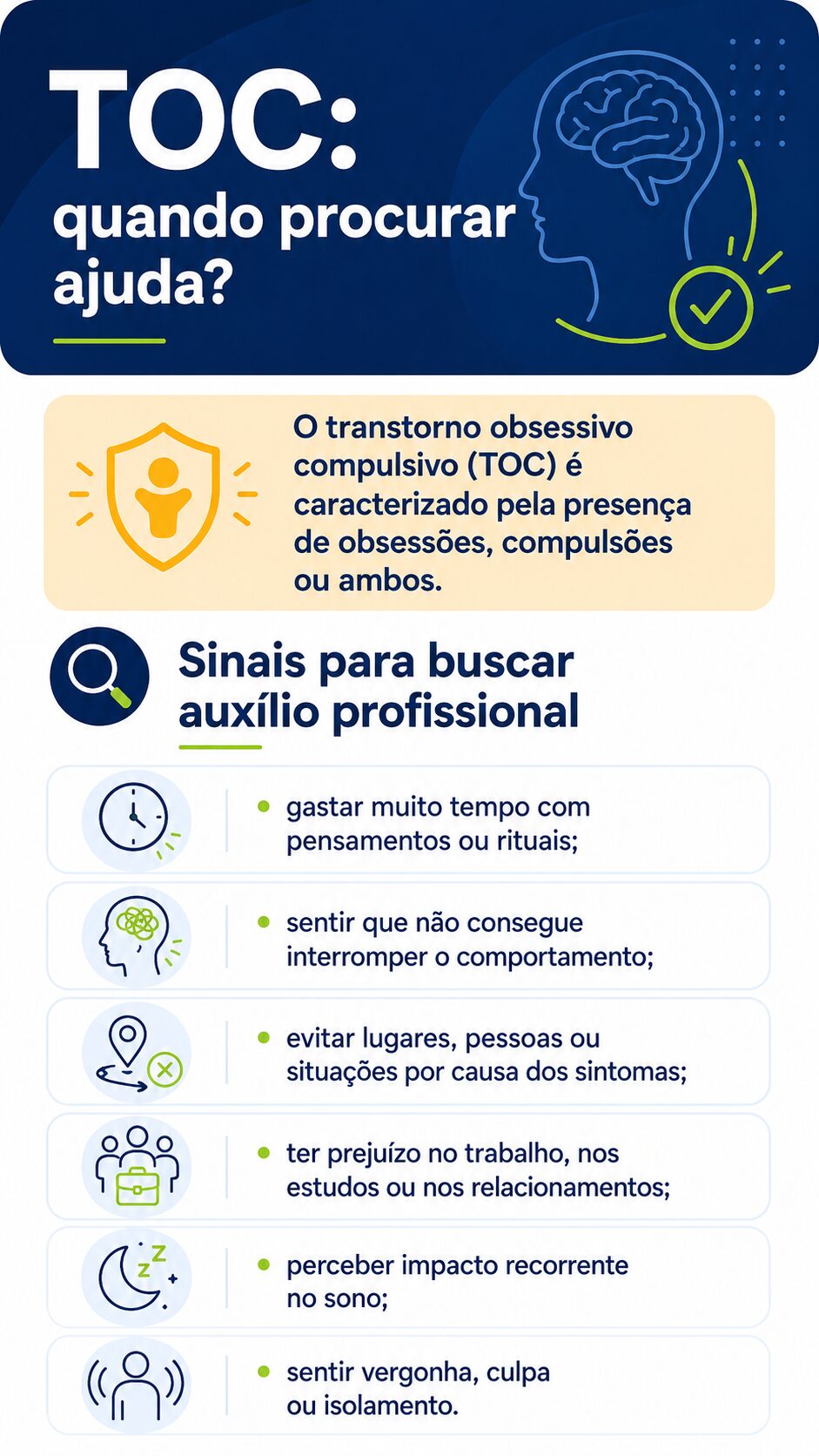
It is worth seeking professional evaluation when intrusive thoughts, rituals, or repetitive behaviors begin to cause suffering or interfere with daily life.
Some signs of attention include:
- spending a lot of time on thoughts or rituals;
- feeling that they cannot stop the behavior;
- avoiding places, people, or situations because of the symptoms;
- suffering impairment in work, studies, or relationships;
- notice recurring impact on sleep;
- feeling shame, guilt, or isolation.
The first step may be to talk to a psychologist or psychiatrist. In the SUS, the Psychosocial Care Centers (CAPS) are public mental health services that provide support to people in mental distress and are staffed by multidisciplinary teams. The Ministry of Health reports that it is also possible to access the CAPS through direct referral, referral from a Primary Care Unit (UBS), UPA, general hospitals, the Emergency Medical Service (SAMU), or other services within the network.
How is OCD treated?
Treatment should be determined by a mental health professional. In general, it may involve psychotherapy, medication, or a combination of both approaches.
Exposure and response prevention, known as EPR or ERP, is a form of cognitive behavioral therapy often used in the treatment of OCD. The NIMH reports that research shows that ERP can reduce compulsive behaviors, including in people who do not respond well to medication.
The International OCD Foundation also describes ERP as a first-line approach for OCD, with strong evidence base, especially when conducted by a trained professional.
Medications can be considered in some cases, always under medical evaluation and prescription.
Frequently asked questions about OCD
Does OCD have a treatment?
Yes. OCD can be treated. Although it is often a chronic disorder, many people experience improvement in symptoms with appropriate follow-up, evidence-based psychotherapy, and in some cases medication. The goal is to reduce suffering, functional impairment, and impact on daily routine.
What is the difference between OCD and anxiety?
OCD often involves anxiety or other intense feelings of discomfort, but it is distinguished by the presence of the obsessive-compulsive cycle. In generalized anxiety, there may be excessive concern about different areas of life. In OCD, there are recurring intrusive thoughts and mental rituals or actions used to relieve distress.
Can a child have OCD?
Yes. The NIMH reports that symptoms of OCD can begin at different times, but they often appear between the end of childhood and the beginning of adulthood. In children, repetitive rituals and distress can be mistaken for “phase disorders,” so professional evaluation is important.
How do I know if I have OCD or if it's just a habit?
The main difference lies in the suffering, the loss of control, the time spent, and the functional impairment. Preferences and habits usually bring comfort or organization. In OCD, rituals are usually performed under internal pressure and generate distress when the person tries to resist them.
Does OCD get worse at night?
Some people report worsening intrusive thoughts at night or difficulty sleeping because of rituals. The literature describes an association between OCD and sleep disorders, but the findings vary. If sleep is being affected on a recurring basis, this is an important point to discuss with a professional.
What causes OCD?
There is no single cause. The NIMH points out that research investigates genetic, biological, temperamental, and adverse childhood experiences factors, but these associations are still being studied. The safest approach is to understand the disorder as the result of multiple factors, not as a personality flaw, weakness, or lack of willpower.
Important: This content is for educational purposes only and does not replace consultation, diagnosis, or treatment by a healthcare professional. If repetitive thoughts or behaviors are causing distress or interfering with your routine, seek guidance from a psychologist or psychiatrist.
Adapted from NIMH and the Ministry of Health.
References consulted
National Institute of Mental Health (NIMH). Obsessive-Compulsive Disorder (OCD).
https://www.nimh.nih.gov/health/topics/obsessive-compulsive-disorder-ocd
Access on: 12 Aug 2026.
National Institute of Mental Health (NIMH). Obsessive-Compulsive Disorder: When Unwanted Thoughts or Repetitive Behaviors Take Over.
https://www.nimh.nih.gov/health/publications/obsessive-compulsive-disorder-when-unwanted-thoughts-or-repetitive-behaviors-take-over
Access on: 12 Aug 2026.
National Institute of Mental Health (NIMH). Obsessive-Compulsive Disorder (OCD) — Statistics.
https://www.nimh.nih.gov/health/statistics/obsessive-compulsive-disorder-ocd
Access on: 12 Aug 2026.
NCBI Bookshelf / National Institutes of Health. Diagnostic criteria — Obsessive-Compulsive Disorder.
https://www.ncbi.nlm.nih.gov/books/NBK56452/
Access on: 12 Aug 2026.
NCBI Bookshelf / National Institutes of Health. DSM-IV to DSM-5 Comparison of Obsessive-Compulsive Disorder.
https://www.ncbi.nlm.nih.gov/books/NBK519704/table/ch3.t13/
Access on: 12 Aug 2026.
International OCD Foundation. What is OCD?
https://iocdf.org/about-OCD/
Access on: 12 Aug 2026.
International OCD Foundation. Exposure and Response Prevention (ERP).
https://iocdf.org/about-ocd/treatment/erp/
Access on: 12 Aug 2026.
International OCD Foundation. OCD Treatment Guide: Exposure and Response Prevention.
https://iocdf.org/about-ocd/ocd-treatment-guide/erp/
Access on: 12 Aug 2026.
Mayo Clinic. Obsessive-compulsive disorder (OCD) — Diagnosis and treatment.
https://www.mayoclinic.org/diseases-conditions/obsessive-compulsive-disorder/diagnosis-treatment/drc-20354438
Access on: 12 Aug 2026.
Paterson JL, Reynolds AC, Ferguson SA, Dawson D. Sleep and obsessive-compulsive disorder (OCD). Sleep Medicine Reviews. 2013.
https://researchnow.flinders.edu.au/en/publications/sleep-and-obsessive-compulsive-disorder-ocd
Access on: 12 Aug 2026.
Ministry of Health. Psychosocial Care Centers (CAPS).
https://www.gov.br/saude/pt-br/composicao/saes/desmad/raps/caps
Access on: 12 Aug 2026.
https://www.nimh.nih.gov/health/publications/generalized-anxiety-disorder-gad
Accessed on: 23 Sep 2026.