













Fall Prevention for Older Adults: How to Reduce Risks and Maintain Independence
Falls should not be considered an inevitable consequence of aging. They are a major public health problem and can lead to fractures, injuries, fear of falling again, reduced mobility, and loss of independence.
According to the Ministry of Health, estimates from the World Health Organization indicate that approximately 28% of older adults experience at least one fall per year. Given the size of Brazil’s older adult population, this would correspond to about 9 million falls per year.
The good news is that many factors associated with falls can be identified and addressed. Prevention involves a combination of health care, appropriate physical activity, medication reviews when indicated, and environmental adjustments.
Why Falls Deserve Attention
A fall can occur for a variety of reasons. In general, there is no single cause, but rather a combination of factors related to the person, their health, and the environment.
Weakness in the lower limbs, changes in gait or balance, vision problems, dizziness, certain medications, chronic diseases, and obstacles inside the home are among the factors that can increase the risk. The more of these factors that are present, the greater the vulnerability tends to be.
International guidelines for fall prevention in older adults also emphasize that falls can be associated with hospitalization, disability, reduced independence, and mortality. Therefore, a fall or frequent episodes of loss of balance should not be treated merely as a lack of attention.
What signs should you look for?
There are certain situations that should be reported to the healthcare team:
- one or more falls in the past 12 months;
- frequent stumbling or loss of balance;
- difficulty walking, getting up from a chair, or climbing stairs;
- fear of falling and a reduction in activities due to a lack of confidence;
- dizziness when standing up or changing position;
- deterioration of vision;
- recent initiation of medication or perception of adverse effects;
- the need to lean on furniture or walls to get around.
Global guidelines recommend that healthcare professionals periodically ask older adults about any falls that have occurred in the past year. When a fall, gait problems, or difficulty with mobility are reported, a more detailed assessment of balance and risk factors may be indicated.
Can medications contribute to falls?
Some medications can cause drowsiness, impaired attention, balance problems, or a drop in blood pressure when standing up. Examples frequently cited include sedatives, tranquilizers, antidepressants, and other medications that affect the central nervous system. Some cardiovascular treatments may also contribute to dizziness or postural hypotension in certain individuals.
This does not mean that these medications are inappropriate or that they should be discontinued. Stopping them on your own can pose significant risks. The Ministry of Health recommends bringing a list of all medications you are taking—including over-the-counter products—to your appointments so that your healthcare team can assess potential adverse effects and interactions.
The use of multiple medications at the same time also warrants attention, especially when dizziness, drowsiness, confusion, weakness, or a recent fall are present. The evaluation should take into account each medication, its dosage, the benefits of treatment, and the person’s clinical condition.
What about cholesterol medications?
Statins may be associated with muscle symptoms in a small proportion of users. However, the presence of pain or weakness during treatment does not necessarily mean that the medication is the cause, and the available evidence does not support the conclusion that statins generally increase the risk of falls.
The American Heart Association reports that muscle symptoms pharmacologically attributable to statins are uncommon. If unexplained muscle pain, tenderness, or weakness occurs, the recommendation is to seek medical evaluation without discontinuing treatment on your own.
Strength and balance help reduce the risk
Regular physical activity helps prevent falls among older adults, as it helps maintain strength, balance, mobility, and the ability to perform daily tasks.
According to the World Health Organization, adults should engage in 150 to 300 minutes of moderate-intensity aerobic activity per week—or 75 to 150 minutes of vigorous-intensity activity—in addition to strength training for the major muscle groups on at least two days a week.
For older adults, the WHO recommends including, on three or more days a week, a variety of activities that work on both functional balance and strength. The intensity and type of exercise should be tailored to each person’s functional capacity, health status, and fitness level.
In programs specifically designed to prevent falls among older adults, international guidelines prioritize exercises that safely challenge balance and functional movements, such as sitting down and standing up, changing direction, and taking controlled steps. These programs should be individualized, progressive, and carried out regularly.
Activities such as walking, weight training, resistance exercises, and tai chi can be part of an exercise routine. Forms of exercise that are more familiar to the Brazilian public, such as Pilates and yoga, also build strength and balance and can contribute to achieving the recommended physical capabilities. A systematic review with a meta-analysis published in the *Archives of Physical Medicine and Rehabilitation* indicates that Pilates can improve balance in older adults, although the evidence regarding its direct effect on reducing falls is limited.
The World Health Organization, meanwhile, points out that yoga—by combining gentle movement, breathing, and mindfulness—promotes balance, flexibility, strength, and mobility, all of which are essential for maintaining independence as we age. These practices are not a substitute for structured fall prevention programs, but they can be a good starting point for those who are just beginning to get active. However, more challenging balance exercises should not be performed near stairs, on slippery floors, or without a secure support.
People who have had previous falls, experience frequent dizziness, have significant limitations, or have chronic conditions may need guidance from a physical therapist, physical education professional, or another member of the healthcare team.
For people who are sedentary, the WHO recommends starting with small amounts of activity and gradually increasing the frequency, duration, and intensity. Some exercise is better than none, as long as it is appropriate for the individual’s condition.
How to Make Your Home Safer
The home environment is an important part of prevention. The Ministry of Health recommends keeping the home organized, well-lit, and free of obstacles.
Some measures include:
- remove or properly secure loose rugs;
- Keep hallways and walkways clear of furniture, boxes, cords, and other objects;
- Install grab bars in the bathroom when necessary;
- use handrails on stairs;
- ensure good lighting, especially between the bedroom and the bathroom;
- avoid wet or waxed floors;
- keep frequently used items in accessible places;
- wear closed-toe, sturdy shoes with non-slip soles;
- monitor the movement of pets;
- Use a cane, walker, or other assistive device when medically recommended.
Canes and walkers should be adjusted to the person’s height and needs. Improper use or use without guidance may not provide the expected stability.
The Role of Vision, Feet, and Overall Health
Vision problems can make it difficult to see steps, obstacles, and changes in elevation. For this reason, the Ministry of Health recommends getting your eyes checked and updating your glasses when necessary.
Foot pain, loss of sensation, deformities, and ill-fitting shoes can also affect gait. People with diabetes should pay special attention to having their feet examined regularly.
Persistent dizziness, a feeling of faintness, balance problems, and recent changes in gait should also be investigated. These symptoms can have various causes and should not be automatically attributed to aging.
Does vitamin D prevent falls?
Vitamin D deficiency may be associated with muscle weakness and is one of the factors assessed in people at risk of falling. This does not mean, however, that all older adults should take supplements to prevent falls.
Global guidelines recommend that supplementation aimed at preventing falls be reserved for people with disabilities or at risk of disability, as determined by a professional assessment. Supplements should not be started on one’s own initiative.
How Family Members and Caregivers Can Help
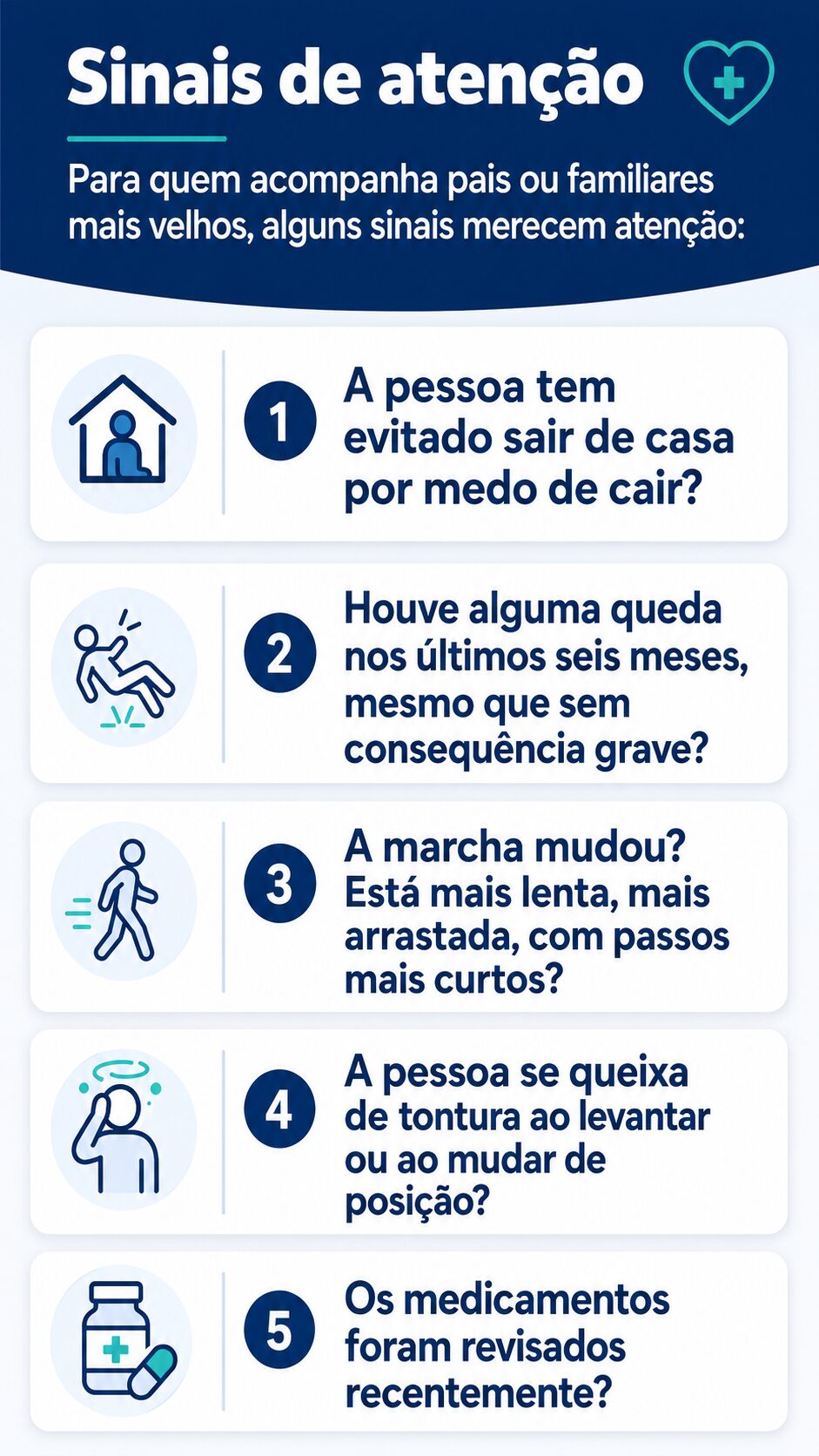
According to the Ministry of Health, family members and caregivers can help by watching for changes that are not always reported on their own, such as:
- fewer outings due to fear of falling;
- the need to lean on furniture;
- shorter strides or a slower pace;
- falls, even without any apparent injury;
- complaints of dizziness or weakness;
- difficulty getting up;
- deterioration in vision or attention;
- changes following the initiation or adjustment of medications.
This information should be shared with the healthcare team. It is also important to respect the older adult’s preferences and involve them in decision-making. International guidelines emphasize that preventive measures are most effective when they are tailored to the individual and take into account each person’s priorities, autonomy, and circumstances.
Prevention also begins before old age
More specific evidence regarding fall prevention programs for older adults, particularly those with a history of falls or mobility limitations. This does not mean that younger adults need to wait to address their functional ability.
Regular physical activity, including aerobic and strength-training exercises, provides lifelong benefits. Staying active helps preserve strength, mobility, and overall health as you age.
More important than setting an exact age to start is establishing a realistic, gradual, and consistent routine.
Frequently Asked Questions
What is the leading cause of falls among older adults?
There is no single cause. Falls are usually the result of a combination of factors, such as changes in strength and balance, problems with gait or vision, certain medications, chronic diseases, and environmental hazards.
Do high blood pressure medications increase the risk of falls?
Some medications may contribute to a drop in blood pressure upon standing, dizziness, or weakness, but the risk varies depending on the medication, the dose, your health conditions, and other treatments you are taking. Do not stop taking the medication on your own. Report any symptoms to your healthcare provider.
Do statins increase the risk of falls?
It cannot be said that statins generally increase the risk of falls. Some people may experience muscle symptoms during treatment, but these symptoms are not necessarily caused by the medication. Unexplained muscle pain or weakness should be evaluated by a healthcare professional.
What exercises help with prevention?
Programs that combine balance, functional movements, and strength training yield the most consistent results. The choice of exercises should take into account individual ability and risk, especially when falls have already occurred.
Is walking enough?
Walking offers health benefits, but fall prevention programs generally also include specific exercises for strength, balance, and function. Therefore, walking alone may not cover all the recommended components.
When should you seek career counseling?
Recent falls, frequent loss of balance, fear of falling, dizziness, difficulty walking or standing up, and changes following the use of medications should be reported to the healthcare team. An assessment can help identify modifiable factors and guide appropriate measures.
This content is intended for educational and informational purposes only. It is not a substitute for an evaluation, diagnosis, or individual guidance from healthcare professionals. Medications should not be started, stopped, or changed without professional guidance. Exercise routines should be tailored to each person’s clinical and functional conditions.