












What is bioequivalence, and how does this test prove that a generic drug acts the same way in the body?
In Brazil, every generic drug must demonstrate that it produces the same therapeutic effect in the body as the reference drug before it reaches pharmacies. This demonstration is not based on opinion, sales history, or the manufacturer’s reputation. It depends on a specific test—conducted on healthy volunteers and analyzed using rigorous statistical methods—called a bioequivalence study. It is this study that underpins, from a technical and regulatory standpoint, the confidence that a generic drug acts in the same way as the original product.
Even so, many people are unaware of what this test actually evaluates, how it is conducted, and why Anvisa considers it the primary criterion for authorizing the sale of a generic drug. The question “Do generics work the same way?” persists in part because the concept of bioequivalence is rarely explained in an accessible way outside of technical circles.
This content explains what bioequivalence is, how the testing process works step by step, what each stage evaluates, and who is responsible for conducting and overseeing these studies. The goal is to provide a clear explanation, based on Anvisa’s official definitions, so that anyone can understand why this process exists and how it ensures the quality of generic drugs available in the country.
Bioequivalence: What This Term Means in Practice
Bioequivalence is the demonstration that two drugs with the same active ingredient, in the same dose and dosage form, have comparable effects in the body. According to the definition adopted by Anvisa and established in the Generic Drugs Law (Law No. 9,787/1999), two products are bioequivalent when they have “comparable bioavailability, when studied under the same experimental design.”.
In practice, this means that the generic drug must demonstrate a rate and extent of absorption of an active ingredient similar to those of the reference drug. The test does not merely assess whether the substance is present in the tablet, but whether it reaches the patient’s blood or urine in a manner consistent with the original product.
The term “bioequivalent” does not mean “identical in every way.” Color, shape, excipients, and packaging may differ. What must be equivalent is how the drug behaves inside the body: how much of the active ingredient is absorbed and how long it takes to reach the expected concentration in the blood.
Bioavailability and bioequivalence: What is the relationship between these two concepts?
Bioavailability is the concept that measures the rate and extent to which an active ingredient is absorbed and becomes available in the bloodstream. According to Anvisa, it is assessed based on the curve showing the drug’s concentration in the blood over time.
Bioequivalence, in turn, is the demonstration that two products have comparable bioavailability. The study compares the generic drug and the reference drug side by side and verifies whether both have similar absorption curves.
To make it easier to understand, think of it this way:
● Bioavailability answers the question: “How much of the active ingredient reaches the bloodstream, and how quickly?”
● Bioequivalence answers the question: “Does the generic drug deliver the active ingredient in a manner comparable to the reference drug?”
Without measuring the bioavailability of the two products, it is impossible to state that they are bioequivalent. For this reason, the two concepts go hand in hand and are frequently linked in the regulation of generic drugs.
How a Bioequivalence Study Works, Step by Step
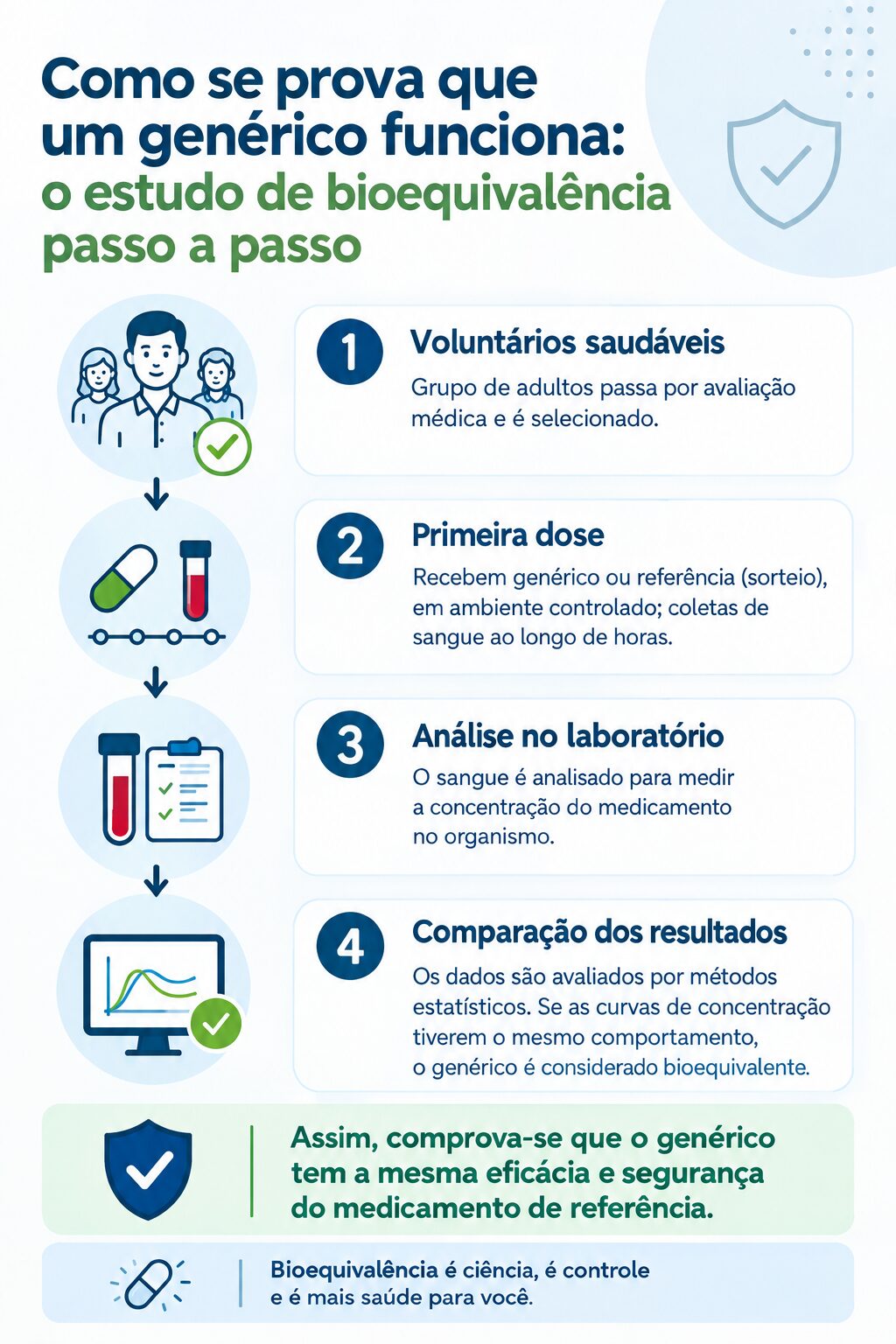
A bioequivalence study follows a standardized experimental design, typically a crossover design. This means that the same volunteers receive both the generic drug and the reference drug at different times. This structure allows for a comparison of how the two products behave in the same organism, eliminating individual variations that could influence the results.
How does a conventional bioequivalence study work?
- Selection of healthy volunteers: A group of adults with no medical conditions that could interfere with drug absorption is recruited and undergoes a preliminary medical evaluation.
- First phase of the study: Volunteers are randomly assigned to receive one of two medications (generic or reference) in a controlled setting. Blood samples are collected at specified intervals over the course of several hours.
- Washout period: the interval between the two study periods, intended to minimize the possibility that the drug administered during the first period will influence the results of the second. The RDC establishes a minimum interval corresponding to five half-lives of the drug or metabolite.
- Second phase of the study: The same volunteers receive the other medication and undergo the same blood collection procedure.
- Laboratory analysis: Blood samples are processed to measure the concentration of the active ingredient at each collection site.
- Statistical evaluation: Data from both periods are compared to verify whether the differences between the generic drug and the reference drug fall within the limits accepted by regulatory authorities.
Every study must be approved by a Research Ethics Committee before it begins, and participants take part voluntarily, with informed consent.
Clinical, analytical, and statistical stages: what each phase assesses
The bioequivalence study is formally divided into three phases, each with distinct responsibilities and objectives.
Clinical phase
This is the phase in which participants receive the medications and have biological samples collected. This stage takes place in a controlled hospital or clinical setting, under the supervision of the study team. The goal is to ensure that medication administration and sample collection strictly follow the protocol, minimizing variables that could compromise the reliability of the data.
During this stage, factors such as meal and hydration schedules can be standardized. Any adverse events are recorded and monitored by the medical team.
Analytical stage
At this stage, the biological samples collected during the clinical phase are sent to a laboratory for quantification of the active ingredient or its metabolite. The analytical methods used must be validated; that is, they must demonstrate precision, accuracy, sensitivity, and stability.
The analytical stage produces the results that will be used in the next phase. The quality of this measurement is critical: analytical errors can invalidate the entire study.
Statistical stage
Concentration data are plotted as time-dependent curves and subjected to statistical analysis. The main parameters evaluated are:
● Cmax: the maximum concentration of the active ingredient in the blood. It indicates the peak absorption.
● Tmax: the time required to reach this maximum concentration.
● AUC (area under the curve): represents the total amount of active ingredient absorbed over time. It is the most important parameter for assessing the extent of absorption.
For a generic drug to be considered bioequivalent, the Cmax and AUC values must fall within a 90% confidence interval ranging from 80% to 125% of the values obtained with the reference drug. This criterion is defined in Anvisa’s current regulation for these studies, RDC No. 742/2022, and is internationally accepted; it is also adopted by the FDA (the U.S. regulatory agency) and the EMA (the European agency).
Who conducts the tests, and how does Anvisa oversee the testing centers?
Bioequivalence studies are conducted by specialized institutions called Bioavailability/Bioequivalence Centers. According to Anvisa’s definition, these centers are research institutions that perform at least one of the three phases of the study (clinical, analytical, or statistical) and are technically and legally responsible for the accuracy of the data.
Each center has a coordinator responsible for the administrative management of the phases under their purview. The team includes physicians, pharmacists, laboratory analysts, and statisticians.
Anvisa certifies and oversees these centers through periodic inspections. The agency verifies that the facilities, equipment, protocols, and documentation comply with Good Clinical Practices and the specific standards for bioequivalence studies. Centers that do not meet the requirements may have their certification suspended or revoked.
This oversight model exists to ensure that study results are reliable and reproducible. It is not enough for a manufacturer to simply claim that its generic drug is bioequivalent: the data must come from certified centers, following validated protocols and under regulatory oversight.
If the generic drug passes the test, does it work the same way?
When a generic drug is approved based on a bioequivalence study, it means that it has been shown to deliver the active ingredient to the body in amounts and at a rate comparable to those of the reference drug. From a pharmacological standpoint, the expected therapeutic effect is the same.
This conclusion is not based on speculation. It is supported by absorption data measured in actual volunteers, analyzed using validated methods, and evaluated according to internationally accepted statistical criteria.
Here are a few important points to provide context for this answer:
- The bioequivalence test is the same criterion used in several countries to approve generic drugs, including the United States, Canada, and countries in the European Union.
- Differences in excipients, color, or tablet shape do not affect bioequivalence, provided that the absorption of the active ingredient remains within the required parameters.
- Passing the test is a mandatory requirement for registering the generic drug with Anvisa. Without it, the drug cannot be marketed.
Therefore, the technical answer is straightforward: if the generic drug has passed the bioequivalence test, it performs comparably to the reference drug in terms of the body’s absorption of the active ingredient.
What to Do If You Have Questions About Your Medication
Even with all the technical and regulatory foundations that support the approval of generic drugs, it is natural for questions to arise regarding individual treatment. Each person has a unique medical history, takes other medications, and may have conditions that influence their response to treatment.
If you have any questions about the medication you are taking, the safest course of action is to speak with the doctor who prescribed the treatment or with the pharmacist in charge. These professionals can assess your specific situation and clarify whether there are any particular considerations that warrant attention.
Some situations in which it’s worth seeking career counseling:
- Switching from a brand-name drug to a generic drug during treatment.
- Perceived difference in effect following a change in brand or packaging.
- Questions about interactions with other medications currently being taken.
- The need to better understand how the active ingredient in your medication works.
Technical information on bioequivalence helps in understanding the regulatory process, but it is no substitute for an individualized clinical evaluation. Trusting generic drugs is backed by science; tailoring treatment to your specific situation requires professional guidance.
Frequently Asked Questions About Bioequivalence
What is bioequivalence, in simple terms?
Bioequivalence is the demonstration that a generic drug releases the active ingredient into the body in amounts and at a rate comparable to those of the reference drug. This is demonstrated through a controlled clinical study, involving the collection of biological samples and statistical analysis of the data.
What is the difference between bioavailability and bioequivalence?
Bioavailability measures how much of a drug's active ingredient enters the bloodstream and how quickly it does so, or how quickly it is eliminated through urine. Bioequivalence is the comparison of the bioavailability of two products (generic and reference) to determine whether they are equivalent.
Who conducts bioequivalence testing?
The tests are conducted by research centers certified by Anvisa, known as Bioavailability/Bioequivalence Centers. These centers undergo regular inspections and bear technical and legal responsibility for the data they produce.
Are bioequivalence tests conducted on people?
Yes. The study is conducted with healthy volunteers who receive both the generic drug and the reference drug at different times. Blood samples are collected to measure the absorption of the active ingredient. The entire process is approved by a Research Ethics Committee.
If a generic drug is bioequivalent, does it work the same as the brand-name drug?
From the perspective of active ingredient absorption, yes. The bioequivalence study demonstrates that the generic drug delivers the active ingredient to the body in a manner comparable to the reference drug, within internationally accepted statistical criteria.
What does the range from 80% to 125% mean in the test?
This interval is the statistical criterion used to assess whether the differences between the generic drug and the reference drug are acceptable. The absorption parameters (Cmax and AUC) of the generic drug must fall within this range relative to the reference drug, with a 90% statistical confidence level.
Does every generic drug undergo bioequivalence testing?
Yes. Passing the bioequivalence study is a mandatory requirement for the registration of any generic drug with Anvisa. Without this proof, the product will not be authorized for sale in Brazil.