







The Difference Between a Heart Attack and Cardiac Arrest: What Each Means and Why Confusing the Two Can Cost Valuable Time
In Brazil, cardiovascular diseases are among the leading public health challenges. According to the Ministry of Health’s BiblioSUS Network, cardiovascular problems caused approximately 400,000 deaths in the country in 2022. Within this context, two conditions often cause fear and confusion: heart attack and cardiac arrest. Although they are frequently used interchangeably, they do not mean the same thing.
The difference isn't just in the name. The American Heart Association explains that a heart attack occurs when blood flow to the heart is blocked, while cardiac arrest occurs when an electrical malfunction causes the heart to stop pumping blood effectively. In simple terms: a heart attack usually occurs when blood flow to a part of the heart is interrupted; cardiac arrest, on the other hand, occurs when the heart stops pumping blood effectively.
Understanding this distinction helps you recognize signs, call emergency services, and act more safely. This content explains how each event occurs, which signs warrant attention, and what initial steps are recommended in an emergency. These guidelines are for educational purposes only and are not a substitute for medical care.
Key Points
According to the American Heart Association, certain details are essential for distinguishing between a heart attack and cardiac arrest:
- A heart attack occurs when a blocked artery prevents blood from reaching a part of the heart.
- Cardiac arrest occurs when an electrical malfunction in the heart causes an irregular heartbeat and the heart stops pumping blood effectively.
- A heart attack can lead to cardiac arrest, but not every case of cardiac arrest is caused by a heart attack.
- A heart attack may cause chest pain, shortness of breath, cold sweats, nausea, dizziness, or unusual fatigue.
- During cardiac arrest, a person usually loses consciousness, is unresponsive, and is not breathing normally.
- If a heart attack or cardiac arrest is suspected, emergency services should be called immediately.
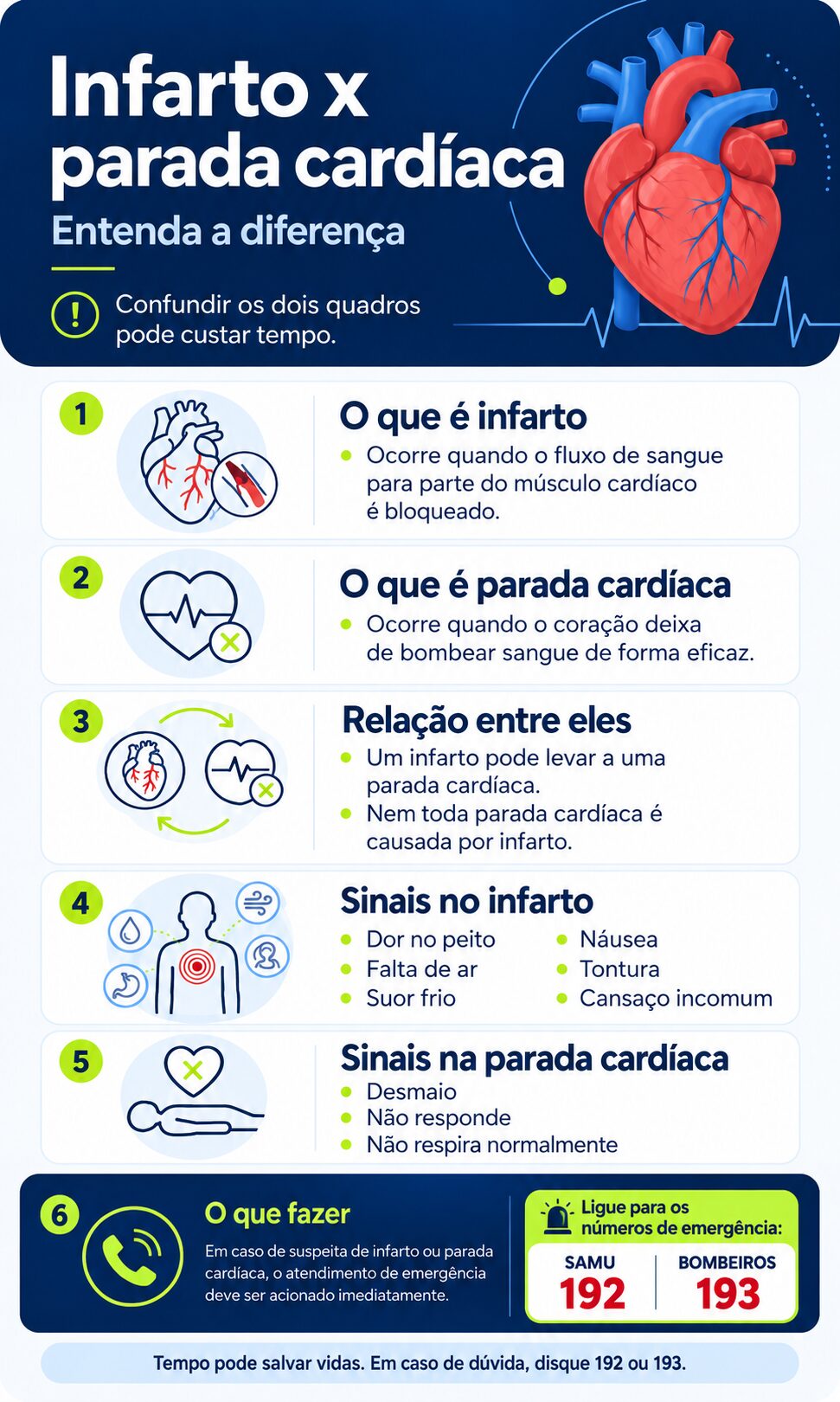
Heart Attack and Cardiac Arrest: Why So Many People Confuse the Two
Confusion between a heart attack and cardiac arrest is common because both are cardiovascular conditions and can occur together in serious situations. But the mechanisms are different. According to the American Heart Association, during a heart attack, the heart generally does not stop beating. The main problem is the obstruction of blood flow, which reduces or interrupts the supply of oxygen to a part of the heart muscle and can lead to the death of cells in that region. In cardiac arrest, the heart stops pumping blood adequately to the brain, lungs, and other organs, and the person suddenly loses consciousness.
For those with risk factors such as high blood pressure, high cholesterol, diabetes, smoking, or a family history of cardiovascular disease, this distinction is important in practical terms. Understanding the situation more clearly can help when communicating with SAMU 192 and in responding during the first few minutes.
What Is a Heart Attack and How Does It Happen?
An acute myocardial infarction occurs when blood flow to a portion of the heart muscle is interrupted. According to the NHLBI/NIH, pain or discomfort in the center or left side of the chest is the most common symptom, but the condition may also involve shortness of breath, nausea, cold sweats, dizziness, and pain in the arm, back, jaw, or neck.
In most cases, a heart attack is related to coronary artery disease and atherosclerosis, a process in which plaque builds up in the arteries. When a plaque ruptures or undergoes changes on its surface, a clot may form, causing a partial or total blockage of blood flow. Without enough oxygen, part of the heart muscle may be damaged.
During a heart attack, the heart may continue to beat, although the rhythm may change, and the situation requires immediate medical attention. This is one of the key differences from cardiac arrest.
What is cardiac arrest?
Cardiac arrest occurs when the heart stops pumping blood effectively. According to the American Heart Association, it is not the same thing as a heart attack. During cardiac arrest, a person may collapse, lose consciousness, become unresponsive, and stop breathing normally. It is a medical emergency that requires immediate action.
The NHLBI/NIH explains that cardiac arrest may be related to complications from coronary artery disease, heart attack, arrhythmias, heart inflammation, trauma, poisoning, drowning, respiratory obstruction, and other causes. Therefore, a heart attack is a possible cause of cardiac arrest, but it is not the only one.
Can a heart attack cause cardiac arrest?
Yes. A heart attack can disrupt the heart’s electrical system and trigger a serious arrhythmia, leading to cardiac arrest. The American Heart Association explains that heart attacks increase the risk of cardiac arrest, but that cardiac arrest can also result from other electrical or structural problems in the heart.
For this reason, symptoms suggestive of a heart attack should not be ignored at home “to see if they go away.” The Ministry of Health advises that, in the event of a suspected heart attack, the patient or someone close to them should contact SAMU by dialing 192.
Warning signs: what to look for
Signs suggestive of a heart attack
The signs of a heart attack can vary from person to person. According to the American Heart Association and the CDC, symptoms may include:
- chest pain, tightness, or discomfort;
- shortness of breath;
- pain or discomfort in the arm, shoulder, back, neck, jaw, or stomach;
- nausea or vomiting;
- cold sweat;
- dizziness or a feeling of faintness;
- unusual fatigue.
In women, chest pain or discomfort is also common, but other symptoms may be more prominent, such as shortness of breath, nausea, vomiting, and pain in the back or jaw, according to the American Heart Association.
Signs suggestive of cardiac arrest
In cases of cardiac arrest, the onset is usually sudden. According to the CDC and the NHLBI/NIH, the main signs are: the person faints or collapses, does not respond, and is not breathing normally.
For the layperson, this is the surest way to recognize a medical emergency: the person is unresponsive and not breathing normally. It is not recommended to waste time trying to check for a pulse if the person is unresponsive and not breathing normally.
What to Do in the First Few Minutes
Facing a Possible Heart Attack
In the event of chest pain or symptoms suggestive of a heart attack, the Ministry of Health advises calling SAMU at 192. The service is part of the mobile emergency response network and is recommended in situations such as a suspected heart attack or stroke.
While waiting for help to arrive, keep the person at rest, avoid physical exertion, and follow the emergency service’s instructions. Do not give the person any medication, food, or liquids without professional guidance. If the person’s condition worsens, they lose consciousness, or their breathing becomes abnormal, treat the situation as a possible cardiac arrest.
In the event of a possible cardiac arrest
If a person faints, is unresponsive, and is not breathing normally, call emergency services and begin chest compressions. The NHLBI/NIH recommends calling emergency services, locating an automated external defibrillator (AED) if available, and performing cardiopulmonary resuscitation (CPR) until emergency personnel arrive.
The American Heart Association recommends firm, rapid compressions in the center of the chest at a rate of 100 to 120 compressions per minute. The organization also emphasizes that immediate CPR can double or triple a cardiac arrest victim’s chances of survival.
If an AED is available, turn on the device and follow the voice prompts. The defibrillator analyzes the heart rhythm and indicates whether a shock is needed. The priority is to avoid delaying care: call for help, begin chest compressions, and follow the emergency service’s instructions.
High blood pressure, cholesterol, and atherosclerosis: the link between the two conditions
Heart attacks and cardiac arrest share important risk factors. The Ministry of Health highlights hypertension, uncontrolled diabetes, and high cholesterol as factors that increase the risk of cardiovascular events, including heart attacks.
High blood pressure can strain the heart and damage blood vessels over time. High LDL cholesterol can contribute to plaque buildup in the arteries, promoting atherosclerosis. The combination of high blood pressure, dyslipidemia, diabetes, smoking, and a sedentary lifestyle increases overall cardiovascular risk.
Prevention, however, should not be presented as a guarantee. It is more accurate to say that controlling blood pressure, monitoring cholesterol levels, engaging in physical activity, eating a balanced diet, not smoking, and attending routine checkups help reduce the risk of cardiovascular events over time.
Frequently Asked Questions About Heart Attacks and Cardiac Arrest
Are a heart attack and cardiac arrest the same thing?
No. A heart attack occurs when blood flow to part of the heart muscle is blocked. Cardiac arrest occurs when the heart stops pumping blood effectively, usually due to an electrical malfunction. These are different mechanisms, although a heart attack can progress to cardiac arrest.
How can you tell if it's a heart attack or cardiac arrest?
During a heart attack, the person may be conscious and report chest pain or discomfort, shortness of breath, cold sweats, nausea, dizziness, or unusual fatigue. In cardiac arrest, the person usually collapses, is unresponsive, and is not breathing normally. In either situation, emergency services should be called.
Is every cardiac arrest caused by a heart attack?
No. A heart attack is a possible cause, but cardiac arrest can also be caused by arrhythmias, structural heart diseases, respiratory disorders, poisoning, trauma, and other conditions, according to the NHLBI/NIH.
Does high blood pressure increase the risk of a heart attack and cardiac arrest?
High blood pressure is one of the leading cardiovascular risk factors. Over time, it can contribute to damage to the arteries and put a strain on the heart. Therefore, controlling blood pressure as directed by a doctor is an important measure for cardiovascular prevention.
What should you do if someone faints and stops breathing normally?
Call emergency services immediately, begin chest compressions in the center of the chest, and use an AED if one is available. The CDC recommends continuing CPR until emergency medical personnel arrive.
Are people with high cholesterol at greater risk of a heart attack?
High cholesterol, especially high LDL, is associated with plaque buildup in the arteries and an increased risk of cardiovascular disease. The evaluation should take into account the individual’s complete health profile, including blood pressure, diabetes, smoking status, age, family history, and other factors.
Is it possible to reduce the risk of both events at the same time?
Yes, it is possible to reduce overall cardiovascular risk through ongoing measures: blood pressure control, cholesterol monitoring, a balanced diet, regular physical activity, quitting smoking, and routine checkups. These measures do not completely eliminate the risk, but they help reduce it.
Important: This content is for educational purposes only and is not a substitute for an evaluation, diagnosis, or guidance from a healthcare professional. If you experience symptoms suggestive of a heart attack or cardiac arrest, seek emergency care immediately.
Sources consulted
BIBLIOSUS NETWORK. Ministry of Health. Approximately 400,000 people died in Brazil in 2022 from cardiovascular problems. Brasília, DF: Ministry of Health. Available at: https://bibliosus.saude.gov.br/cerca-de-400-mil-pessoas-morreram-em-2022-no-brasil-por-problemas-cardiovasculares/. Accessed on: Aug. 6, 2026.
AMERICAN HEART ASSOCIATION (AHA). Differences Between Heart Attacks and Sudden Cardiac Arrest. Dallas: AHA. Available at: https://www.heart.org/en/health-topics/cardiac-arrest/about-cardiac-arrest/heart-attack-or-sudden-cardiac-arrest-how-are-they-different. Accessed on: Aug. 6, 2026.
AMERICAN HEART ASSOCIATION (AHA). Treatment of Cardiac Arrest. Dallas: AHA. Available at: https://www.heart.org/en/health-topics/cardiac-arrest/emergency-treatment-of-cardiac-arrest. Accessed on: Aug. 6, 2026.
BRAZIL. Ministry of Health. Heart Attack. Brasília, DF: Ministry of Health. Available at: https://www.gov.br/saude/pt-br/assuntos/saude-de-a-a-z/i/infarto. Accessed on: Aug. 6, 2026.
NATIONAL HEART, LUNG, AND BLOOD INSTITUTE (NHLBI/NIH). How the Heart Works: How Blood Flows Through the Heart. Bethesda: NHLBI. Available at: https://www.nhlbi.nih.gov/health/heart/blood-flow. Accessed on: Aug. 6, 2026.
NATIONAL HEART, LUNG, AND BLOOD INSTITUTE (NHLBI/NIH). What Is a Heart Attack? Bethesda: NHLBI. Available at: https://www.nhlbi.nih.gov/health/heart-attack. Accessed on: Aug. 6, 2026.
MAYO CLINIC. Arteriosclerosis / atherosclerosis: symptoms and causes. Rochester: Mayo Foundation for Medical Education and Research. Available at: https://www.mayoclinic.org/diseases-conditions/arteriosclerosis-atherosclerosis/symptoms-causes/syc-20350569. Accessed on: Aug. 6, 2026.
BRAZILIAN SOCIETY OF CARDIOLOGY. Update to the SBC Cardiovascular Prevention Guidelines. Brazilian Archives of Cardiology, 2019. Available at: https://www.scielo.br/j/abc/a/SMSYpcnccSgRnFCtfkKYTcp/?lang=pt. Accessed on: Aug. 6, 2026.
BRAZILIAN SOCIETY OF CARDIOLOGY. Brazilian Guidelines on Arterial Hypertension – 2020/2025. Brazilian Archives of Cardiology. Available at: https://abccardiol.org/. Accessed Aug. 6, 2026.